I have now gone through the ruling from the Supreme Court in the Philippines and posted a press release about this on our website at:
http://www.babymilkaction.org/press/press10oct07.html
As I wrote yesterday, there is disappointing news that the outright ban on advertising of milks for young children has not been upheld. The schedule of fines proposed by the Department of Health has also been rejected.
But everything else in the Revised Implementing Rules and Regulations (RIRR) stands!
The press release and a document analysing the ruling gives full details.
Here I want to flag up some of the protection that has been won regarding labelling. On Friday I wrote about the court case in Belgium where a couple lost their legal action agasint Nestlé over contaminated formula. Nestlé does not warn on its labels that powdered infant formula is not sterile and may contain harmful bacteria and how to reduce the risks. But the Judge found for Nestlé as it complied with the legislation.
Well, the regulations that now come into force in the Philippines with the lifting of the Temporary Restraining Order do require warnings on labels. The industry was trying to strike this down. It doesn't want to warn people of the risks, no doubt fearing it may effect sales.
The Supreme Court threw the objections out. The ruling states:
---Extract begins
The label of a product contains information about said product intended for the buyers thereof. The buyers of breastmilk substitutes are mothers of infants, and Section 26 of the RIRR merely adds a fair warning about the likelihood of pathogenic microorganisms being present in infant formula and other related products when these are prepared and used inappropriately.
[The industry’s] Petitioner’s counsel has admitted during the hearing on June 19, 2007 that formula milk is prone to contaminations and there is as yet no technology that allows production of powdered infant formula that eliminates all forms of contamination.
Ineluctably, the requirement under Section 26(f) of the RIRR for the label to contain the message regarding health hazards including the possibility of contamination with pathogenic micororganisms is in accordance with Section 5(b) of the Milk Code.
---extract ends
So there you have it. The industry admitted formula is prone to contamination, but challenged the requirement that warn people!
Now they will have to. At least in the Philippines. We, and our partners in the Baby Feeding Law Group, are calling for the UK Government to take similar action as set out in the report Protecting breastfeeding. Protecting infants fed on formula.
The Supreme Court also rejected the industry challenge to the rules on health claims. The ruling states:
---Extract begins
[Another section] of the RIRR prohibits all health and nutrition claims for products within the scope of the Milk code, such as claims of increased emotional and intellectual abilities of the infant and young child.
These requirements and limitations are consistent with the provisions of Section 8 of the Milk Code.
---extract ends
If you have visited this blog before you may well be familiar with Nestlé's claim in the Philippines that its formula contains 'brain building blocks' which, as well as being idealzing, is not substantiated by the science. See, for example:
http://boycottnestle.blogspot.com/2007/07/nestle-war-philippines.html
The UK authorities embarked on a crackdown on illegal claims here at the turn of the year, which was picked up in the media in the Philippines and, who knows, may have helped set an example for the authorities there. We need to maximise the protection for infant health and parents by learning from each other.
While the Supreme Court rejected the outright ban on advertising in the Philippines, this was on the technical grounds that the Department of Health had over stretched its right to 'control' advertising. As the press release explains, an Inter-Agency Committee will have the power to pre-approve all advertising and marketing materials and require changes or disapprove anything that is not scientific and factual or implies formula feeding is equivalent or superior to breastfeeding. Properly exercised this will stop the type of promotion exposed in the UNICEF film, Formula for Disaster.
However, we know from experience in the UK that regulatory authorities are not always effective and we advocate an outright ban on company promotion in the UK as well as in the Philippines. In both places we call on legislators to strengthen laws.
Given the power of the baby food industry it is a tough job and it is not always possible to achieve all goals in one go. As the examples of the gains set out above show, the authorities now have strengthened tools, even if not as sharp as we might like. The campaigning must continue, including monitoring to see what does and does not change in the coming weeks and months.
As Senator Pia S. Cayetano, Chair of the Health Committee said today: "From the judiciary, the battlefront has just shifted to the legislature. Admittedly, the process may take time and could be drawn-out. But this would be the proper course of action, as the Supreme Court itself had recommended in its decision." See:
Battle over infant formula ad ban now shifts to Congress
Many thanks once again for your support in the phase of the campaign for the Philippines that has just ended.
We hope you are as tireless as we and our partners try to be.
Wednesday, October 10, 2007


Tuesday, October 09, 2007
Partial victory at Philippines Supreme Court goes some way to protecting infant health - but action is still needed
The Supreme Court in the Philippines has published a 53-page ruling on the Deparment of Health's Revised Implementing Rules and Regulations (RIRR) for the marketing of baby foods.
The Pharmaceutical and Health Care Association of the Philippines (PHAP) petitioned the Supreme Court to block the regulations last year. When that move failed, the US Chamber of Commerce put pressure on the President of the country, threatening investment if the regulations stood. Four days later the Supreme Court imposed a Temporary Restraining Order on the RIRR. We mounted a petition of solidarity with the people of the Philippines which you may have signed. This helped bring media attention to the issue and showed the world was watching.
The order has now been lifted meaning the regulations come into force, though the Court ruled against some of the provisions they contain.
I am awaiting a full copy of the ruling, but from what I hear from colleagues in the Philippines, there is some good news.
The Department of Health wanted to include milks for older babies and children in the scope of the regulations. This now goes ahead, though not the outright ban on advertising that was wanted.
The Department of Health requirements on labelling also go ahead, meaning companies can be required to warn parents that powdered formula is not sterile and may contain harmful bacteria and compelled to include instructions on how to reduce risks. This is extremely important as the case in Belgium I wrote about last week demonstrates. See:
http://boycottnestle.blogspot.com/2007/10/ruling-in-belgium.html
The decision recognises the Department of Health's right to update the regulations, as specified in the 1986 Milk Code (known as EO51) and, in particular, the Department's right to decide whether donations and sponsorship from the baby food industry is acceptable or not. The industry's argument that this was a restriction on trade was rejected.
The bad news is that the outright prohibition on advertising of milks for older babies was not upheld. If you have seen the UNICEF Philippines film, you will know that these are widely advertised with idealizing claims.
Although there will be no outright ban without changing the primary legislation, the Court decision means these advertisements now come within the scope of the Inter Agency Committee which screens advertisements. If the independence of the Committee can be achieved, then it will be able to remove idealizing claims, such as those suggesting formula develops a child's intelligence. So television advertisements promoting milks by showing a child giving a violin recital may soon be a thing of the past.
I was asked for a quote for the media in the Philippines.
Mike Brady, Campaigns and Networking Coordinator at Baby Milk Action, said:
“The many people and organisations around the world who signed our petition of solidarity with the people of the Philippines will welcome the news that the right of the Department of Health to issue the regulations called for by EO51 has been upheld.
"However, I understand the ruling does strike down some of the provisions, such as the ban on advertising of breastmilk substitutes pointing instead to improved vetting of these. The proposed outright ban would undoubtedly have done more to protect infant health, providing clarity for all involved. The claims made by companies about formula feeding are shockingly idealizing and we hope that the vetting committee will take a strong line in prohibiting these claims.
“Health campaigners in the Philippines have had to withstand great pressure from the industry in putting infant health first and they are an inspiration to others around the world. It is never easy holding powerful vested interests to account and this partial victory offers great encouragement to us all.”
Now the restraining order on the RIRR has been lifted urgent action is needed to stop advertisements such as this from Wyeth (makers of SMA) for Bonakid milks from 22 September 2007:
 While the Inter Agency Committee will now be able to pre-screen such advertising and reject inaccurate claims (such as the suggestions in this advertisement that the milk develops intelligence and protects against immunity), it would be much clearer for all involved if there was an outright ban on advertising of such milks.
There are various bills before Congress - including a spoiling one containing industry demands - so while celebrating the partial victory at the Supreme Court, campaigning will continue to close the loopholes that the Court has allowed to remain.
We will issue a press release shortly.
The Pharmaceutical and Health Care Association of the Philippines (PHAP) petitioned the Supreme Court to block the regulations last year. When that move failed, the US Chamber of Commerce put pressure on the President of the country, threatening investment if the regulations stood. Four days later the Supreme Court imposed a Temporary Restraining Order on the RIRR. We mounted a petition of solidarity with the people of the Philippines which you may have signed. This helped bring media attention to the issue and showed the world was watching.
The order has now been lifted meaning the regulations come into force, though the Court ruled against some of the provisions they contain.
I am awaiting a full copy of the ruling, but from what I hear from colleagues in the Philippines, there is some good news.
The Department of Health wanted to include milks for older babies and children in the scope of the regulations. This now goes ahead, though not the outright ban on advertising that was wanted.
The Department of Health requirements on labelling also go ahead, meaning companies can be required to warn parents that powdered formula is not sterile and may contain harmful bacteria and compelled to include instructions on how to reduce risks. This is extremely important as the case in Belgium I wrote about last week demonstrates. See:
http://boycottnestle.blogspot.com/2007/10/ruling-in-belgium.html
The decision recognises the Department of Health's right to update the regulations, as specified in the 1986 Milk Code (known as EO51) and, in particular, the Department's right to decide whether donations and sponsorship from the baby food industry is acceptable or not. The industry's argument that this was a restriction on trade was rejected.
The bad news is that the outright prohibition on advertising of milks for older babies was not upheld. If you have seen the UNICEF Philippines film, you will know that these are widely advertised with idealizing claims.
Although there will be no outright ban without changing the primary legislation, the Court decision means these advertisements now come within the scope of the Inter Agency Committee which screens advertisements. If the independence of the Committee can be achieved, then it will be able to remove idealizing claims, such as those suggesting formula develops a child's intelligence. So television advertisements promoting milks by showing a child giving a violin recital may soon be a thing of the past.
I was asked for a quote for the media in the Philippines.
Mike Brady, Campaigns and Networking Coordinator at Baby Milk Action, said:
“The many people and organisations around the world who signed our petition of solidarity with the people of the Philippines will welcome the news that the right of the Department of Health to issue the regulations called for by EO51 has been upheld.
"However, I understand the ruling does strike down some of the provisions, such as the ban on advertising of breastmilk substitutes pointing instead to improved vetting of these. The proposed outright ban would undoubtedly have done more to protect infant health, providing clarity for all involved. The claims made by companies about formula feeding are shockingly idealizing and we hope that the vetting committee will take a strong line in prohibiting these claims.
“Health campaigners in the Philippines have had to withstand great pressure from the industry in putting infant health first and they are an inspiration to others around the world. It is never easy holding powerful vested interests to account and this partial victory offers great encouragement to us all.”
Now the restraining order on the RIRR has been lifted urgent action is needed to stop advertisements such as this from Wyeth (makers of SMA) for Bonakid milks from 22 September 2007:
 While the Inter Agency Committee will now be able to pre-screen such advertising and reject inaccurate claims (such as the suggestions in this advertisement that the milk develops intelligence and protects against immunity), it would be much clearer for all involved if there was an outright ban on advertising of such milks.
There are various bills before Congress - including a spoiling one containing industry demands - so while celebrating the partial victory at the Supreme Court, campaigning will continue to close the loopholes that the Court has allowed to remain.
We will issue a press release shortly.
Monday, October 08, 2007
Philippines campaigner for infant health launches petition calling for US support
One of the organisers of simultaneous breastfeeding world record events has initiated a petition calling for support for infant health in the Philippines, directed to the people and leaders of the US. Last year the US Chamber of Commerce wrote to the President of the Philippines threatening investment in the country if regulations for the marketing of baby foods are allowed to stand. See our Campaign for Ethical Marketing action sheet and past blogs.
You can see the full petition and sign it yourself at:
http://www.petitiononline.com/probf1/petition.html
Here is the opening text:
---extract begins
To: The People and Leaders of the United States of America
Help us save 16,000 Filipino children’s lives every year and 1.5 million babies dying every year throughout the world, because they were not breastfed.
To counter the mounting pressure that US officials and businessmen exert against breastfeeding advocates and Philippine health officials to prevent them from strictly implementing the laws that protect breastfeeding, the initiator of this petition-signing organized two simultaneous breastfeeding Guinness World Records in single and multiple sites in the Philippines, synchronized breastfeeding worldwide and initiated Senate and Congress hearings in her country. The battle has reached the Supreme Court and the case is still being adjudicated. The case constitutes a precedent that may affect the Breastfeeding Movement in the entire world, especially in developing countries where the financial muscle of multinational corporations and official American pressure are influencing national policies.
We humbly submit for your consideration this petition to the people and leaders of the United States from the mothers and breastfeeding advocates of the world, in consideration of the coming US presidential election, and the opportunity it provides us who are gathered here from all over the world, to acquaint them of our concerns, especially those of the poor countries, that they may better exercise their role as the leader and role model of the world.
This petition was circulated during the 50th Anniversary International Conference of the La Leche League International in Chicago, USA last July 20-23, 2007.
Elvira L. Henares-Esguerra, MD, FPDS, RPh, IBCLC
Director and Co-Founder
Children for Breastfeeding, Inc., Philippines
TESDA Women’s Center, Taguig City, Metro Manila, Philippines
children_for_breastfeeding@yahoo.com
---extract ends
Baby Milk Action has collected signatures to a petition of solidarity with the Philippines and presented this to the Philippines Embassy in London last year and sent the completed petition to the Secretary of State for Health, our IBFAN partners in the Philippines (Arugaan) and others, prior to the closing presentation in the Supreme Court case. This is hearing the baby food industry's challenge to regulations introduced by the Department of Health.
See the blog entries tagged 'Philippines' for further details.
You can see the full petition and sign it yourself at:
http://www.petitiononline.com/probf1/petition.html
Here is the opening text:
---extract begins
To: The People and Leaders of the United States of America
Help us save 16,000 Filipino children’s lives every year and 1.5 million babies dying every year throughout the world, because they were not breastfed.
To counter the mounting pressure that US officials and businessmen exert against breastfeeding advocates and Philippine health officials to prevent them from strictly implementing the laws that protect breastfeeding, the initiator of this petition-signing organized two simultaneous breastfeeding Guinness World Records in single and multiple sites in the Philippines, synchronized breastfeeding worldwide and initiated Senate and Congress hearings in her country. The battle has reached the Supreme Court and the case is still being adjudicated. The case constitutes a precedent that may affect the Breastfeeding Movement in the entire world, especially in developing countries where the financial muscle of multinational corporations and official American pressure are influencing national policies.
We humbly submit for your consideration this petition to the people and leaders of the United States from the mothers and breastfeeding advocates of the world, in consideration of the coming US presidential election, and the opportunity it provides us who are gathered here from all over the world, to acquaint them of our concerns, especially those of the poor countries, that they may better exercise their role as the leader and role model of the world.
This petition was circulated during the 50th Anniversary International Conference of the La Leche League International in Chicago, USA last July 20-23, 2007.
Elvira L. Henares-Esguerra, MD, FPDS, RPh, IBCLC
Director and Co-Founder
Children for Breastfeeding, Inc., Philippines
TESDA Women’s Center, Taguig City, Metro Manila, Philippines
children_for_breastfeeding@yahoo.com
---extract ends
Baby Milk Action has collected signatures to a petition of solidarity with the Philippines and presented this to the Philippines Embassy in London last year and sent the completed petition to the Secretary of State for Health, our IBFAN partners in the Philippines (Arugaan) and others, prior to the closing presentation in the Supreme Court case. This is hearing the baby food industry's challenge to regulations introduced by the Department of Health.
See the blog entries tagged 'Philippines' for further details.
Friday, October 05, 2007
Ruling in Belgium : deaths from contaminated formula are to be accepted
News arrives from Belgium that a family has lost its legal action against Nestlé and the hospital that put their new-born child onto infant formula that turned out to be contaminated with bacteria. The effect of the ruling is to suggest that deaths from intrinsic contamination of formula, which are rare, are to be expected and accepted.
The couple's son became ill with meningitis and died at 5 days old. This was linked to Enterobacter Sakazakii contamination in Nestlé Beba infant formula, prompting a recall. See the International Baby Food Action (IBFAN)'s press release from 10 May 2002.
This death and others in France prompted action at the World Health Assembly. IBFAN called for improved labelling to warn of the risks and how to reduce them. This call was reflected in the Resolution adopted shortly afterwards (WHA 55.25) and more explicitely in 2005 (WHA 58.32) after the World Health Organisation had held an expert meeting.
We are now working for improved labelling standards at the Codex Alimentarius Commission, whose standards are seen to carry greater weight than World Health Assembly Resolutions in that the World Trade Organisation looks to them if evaluating whether national measures are proportionate should there be a trade dispute. The baby food industry is at Codex in force, attempting to weaken measures that could impact on its profits. We have called for greater transparency on conflicts of interest in the past, much to the annoyance of the Chair (see Update 37 for example).
The issue of contamination of powdered infant formula has been known about for decades and the Food and Drug Administration in the United States quotes a study that shows it is worryingly common, found in 14% of tins surveyed. See my earlier blog on Enterobacter Sakazakii for links to references.
In 2005 the UK Food Standards Agency (FSA) issued guidance for parents saying to use water of at least 70 Deg. C to make up the formula to kill any pathogens. As we reported in Update 38 the Northern Ireland Department of Health and the Welsh Assembly Government issued booklets giving this information and stating clearly that formula is not sterile and may contain harmful bacteria.
As we have exposed, companies have still not brought their labels into line, despite issuing new labels this year in response to a crackdown on the use of illegal health claims. See our press release:
http://www.babymilkaction.org/press/press10aug07.html
The UK Government is revising the Infant Formula and Follow-on Formula Regulations and last week we submitted a report on behalf of the Baby Feeding Law Group (BFLG) which calls for a statutory requirement for warnings and instructions on labels to be in line with official guidance. The Food Standards Agency had proposed a voluntary agreement. As the companies didn't bring their labels into line when they had the chance, it is clearly not sensible to rely on their good intentions.
The BFLG report refers to a spot check of company carelines we conducted. This found that advisors are giving advice to parents that contradicts the independent, expert guidance from the Food Standards Agency and World Health Organisation. We have heard claims on carelines that powdered formula is sterile until opened and to make up formula using water at room temperature, which has been pre-boiled. This is dangerous information. The fact is the water needs to be added to the formula at high temperature to kill any bacteria. We will issue a full report on the monitoring in due course.
My view is that it should be a criminal offence for companies to deny parents critically important information about reducing risks from formula on the label.
I understand the Judge in the Belgium case cleared the hospital of negligence as it was not the source of the infection and cleared Nestlé as it had complied with the relevant legislation. No matter that Nestlé was well aware that powdered infant formula is not sterile and may contain harmful bacteria, which it did not warn about on its labels. The parents are in my view justifiably aggrieved at only learning this information after their child died.
If more infants die from contaminated formula prepared using the advice from the carelines or labels a UK judge may well rule company had complied with the law. This is why we think it is so dangerous for the FSA to pursue a voluntary agreement with the industry about warnings and instructions instead of setting out in the legislation that they must comply with official guidance to parents.
Fortunately deaths from contaminated formula are rare, though it is unknown how much the higher incidence of gastroenteritis and other illness is due to contamination as this has not been monitored.
Personally I think the idea that deaths from contaminated formula are to be expected and accepted, as the Belgian ruling suggests, is not the correct response to the tragedies that have occurred. Action must be taken to ensure parents have the information they need to reduce risks.
If you agree please support our work and sign up to receive information from our making formula use safer campaign.
The couple's son became ill with meningitis and died at 5 days old. This was linked to Enterobacter Sakazakii contamination in Nestlé Beba infant formula, prompting a recall. See the International Baby Food Action (IBFAN)'s press release from 10 May 2002.
This death and others in France prompted action at the World Health Assembly. IBFAN called for improved labelling to warn of the risks and how to reduce them. This call was reflected in the Resolution adopted shortly afterwards (WHA 55.25) and more explicitely in 2005 (WHA 58.32) after the World Health Organisation had held an expert meeting.
We are now working for improved labelling standards at the Codex Alimentarius Commission, whose standards are seen to carry greater weight than World Health Assembly Resolutions in that the World Trade Organisation looks to them if evaluating whether national measures are proportionate should there be a trade dispute. The baby food industry is at Codex in force, attempting to weaken measures that could impact on its profits. We have called for greater transparency on conflicts of interest in the past, much to the annoyance of the Chair (see Update 37 for example).
The issue of contamination of powdered infant formula has been known about for decades and the Food and Drug Administration in the United States quotes a study that shows it is worryingly common, found in 14% of tins surveyed. See my earlier blog on Enterobacter Sakazakii for links to references.
In 2005 the UK Food Standards Agency (FSA) issued guidance for parents saying to use water of at least 70 Deg. C to make up the formula to kill any pathogens. As we reported in Update 38 the Northern Ireland Department of Health and the Welsh Assembly Government issued booklets giving this information and stating clearly that formula is not sterile and may contain harmful bacteria.
As we have exposed, companies have still not brought their labels into line, despite issuing new labels this year in response to a crackdown on the use of illegal health claims. See our press release:
http://www.babymilkaction.org/press/press10aug07.html
The UK Government is revising the Infant Formula and Follow-on Formula Regulations and last week we submitted a report on behalf of the Baby Feeding Law Group (BFLG) which calls for a statutory requirement for warnings and instructions on labels to be in line with official guidance. The Food Standards Agency had proposed a voluntary agreement. As the companies didn't bring their labels into line when they had the chance, it is clearly not sensible to rely on their good intentions.
The BFLG report refers to a spot check of company carelines we conducted. This found that advisors are giving advice to parents that contradicts the independent, expert guidance from the Food Standards Agency and World Health Organisation. We have heard claims on carelines that powdered formula is sterile until opened and to make up formula using water at room temperature, which has been pre-boiled. This is dangerous information. The fact is the water needs to be added to the formula at high temperature to kill any bacteria. We will issue a full report on the monitoring in due course.
My view is that it should be a criminal offence for companies to deny parents critically important information about reducing risks from formula on the label.
I understand the Judge in the Belgium case cleared the hospital of negligence as it was not the source of the infection and cleared Nestlé as it had complied with the relevant legislation. No matter that Nestlé was well aware that powdered infant formula is not sterile and may contain harmful bacteria, which it did not warn about on its labels. The parents are in my view justifiably aggrieved at only learning this information after their child died.
If more infants die from contaminated formula prepared using the advice from the carelines or labels a UK judge may well rule company had complied with the law. This is why we think it is so dangerous for the FSA to pursue a voluntary agreement with the industry about warnings and instructions instead of setting out in the legislation that they must comply with official guidance to parents.
Fortunately deaths from contaminated formula are rare, though it is unknown how much the higher incidence of gastroenteritis and other illness is due to contamination as this has not been monitored.
Personally I think the idea that deaths from contaminated formula are to be expected and accepted, as the Belgian ruling suggests, is not the correct response to the tragedies that have occurred. Action must be taken to ensure parents have the information they need to reduce risks.
If you agree please support our work and sign up to receive information from our making formula use safer campaign.
Thursday, October 04, 2007
Free Burma

Click on the above image for information on this solidarity campaign by the blogging world.
Also see:
Nestle in Burma - and apartheid South Africa
Wednesday, October 03, 2007
Chivers jelly and the list of products from which Nestle profits
Someone emailed this week to ask if Chivers jelly still has a connection with Nestlé. These were branded as Rowntree after Nesté sold off a range of products a while ago, meaning Nestlé continued to profit from the licence for use of the Rowntrees name and we listed them on that basis.
The new owners have now rebranded as Hartley's jelly, to escape the licence fee and the boycott, I presume.
Other companies have kept us informed when they have broken the link with Nestlé so we remove them from the list of products from which Nestlé profits, such as Tartex and Libby's juices in Europe.
You can find the latest UK boycott list at:
http://www.babymilkaction.org/pages/products.html
We produce credit-card sized lists of principal brands. These are available in packs of 10 or 100 in our on-line Virtual Shop. See:
http://www.babymilkaction.org/shop/boycott.html#product
The new owners have now rebranded as Hartley's jelly, to escape the licence fee and the boycott, I presume.
Other companies have kept us informed when they have broken the link with Nestlé so we remove them from the list of products from which Nestlé profits, such as Tartex and Libby's juices in Europe.
You can find the latest UK boycott list at:
http://www.babymilkaction.org/pages/products.html
We produce credit-card sized lists of principal brands. These are available in packs of 10 or 100 in our on-line Virtual Shop. See:
http://www.babymilkaction.org/shop/boycott.html#product
Tuesday, October 02, 2007
Protecting babies in emergencies: The role of the public
Our partners in the International Baby Food Action Network (IBFAN) in Switzerland have been working on this guide with the Emergency Nutrition Network.
http://www.ennonline.net/ife/generalpublic/default.aspx
Here's the introduction:
---
---
You can read the sections on line or download the full guide as a pdf.
http://www.ennonline.net/ife/generalpublic/default.aspx
For past blog entries on infant feeding in emergencies in places such as Peru, Iraq and the UK, see the 'Past blogs by topic links' to 'HIV and emergencies'.
http://www.ennonline.net/ife/generalpublic/default.aspx
Here's the introduction:
---
Every year, natural and man-made disasters and emergencies affect hundreds of thousands of people. Whenever there is an emergency, we think of the children who have been affected and want to do something to help them. In particular, those of us who are parents imagine ourselves in the emergency and envisage the desperation of struggling to care for a baby or young child under such circumstances.
We give generously to appeals to help children affected by disasters. However, the sort of aid that will assist babies and young children is of a very specific type. It is very important to make sure that our donations help children and do not harm them and to ensure that governments and aid agencies do the same.
This guide has been prepared by the IFE Core Group and collaborators to help you understand the important role of the general public in protecting and supporting infants and young children caught up in crisis worldwide. Focusing on infant and young child feeding, this guide includes a description of what happens on the ground in emergencies, works to dispel some myths surrounding infant feeding in emergencies and most importantly, details on what you can do to help. Sample letters are included to get you started. We welcome feedback on what you think of this guide, and how you have used it.---
You can read the sections on line or download the full guide as a pdf.
http://www.ennonline.net/ife/generalpublic/default.aspx
For past blog entries on infant feeding in emergencies in places such as Peru, Iraq and the UK, see the 'Past blogs by topic links' to 'HIV and emergencies'.
Monday, October 01, 2007
Nestle in Burma - and apartheid South Africa
Now that Buddhist monks and others are challenging the regime in Burma, it is worth remembering Nestlé's support for the oppressive regime there.

This picture from 13 July 2001 shows Business Development Manager Khun Suravath Pinsunwanbutr of Nestle Trading Limited Myanmar Representative Office presenting gifts to the Myanmar Maternal and Child Welfare Association Chairperson of MMCWA Professor Daw Kyu Kyu Swe and Vice-Chairperson Dr Daw Khin Win Shwe (wife of then Chief of Intelligence and later Prime Minister, General Khin Nyunt).
The Global Unions organisations reports that Health Minister Maj-Gen Ket Sein received Nestlé Vice-President Mr Khun Nophadol Siwabutr in 2001, prompting a response from the company - the pdf can be downloaded by clicking here.
Nestlé said it employes three staff in Burma and its business is conducted through a third party.
Nestlé said: "Nestlé does business in nearly all countries in the world, and our products are found in widely diverse political settings. As we provide basic food products, it is recognized that refusing to do business in a country would result in a worsening of the diet and nutritional status of the population. Therefore, we do not refuse to do business in individual countries, but work for social and economic development trhough our business activities."
It is an intersting point and it is worth reiterating that the Nestlé boycott list does not include Nestlé formula because there may be times when it is necessary, but there are two other facts to be taken into account.
Firstly, Burma's pro-democracy movement, led by Nobel Laureate Aung San Suu Kyi, has called on foreign companies to disinvest. While the above event was in 2001 there is no indication the situation has changed and a 2006 report states that Fraser and Neave Holdings is manufacturing other Nestlé products for the Burma/Myanmar market.
Secondly, in the picture at the top the Nestlé executive is donating tins of Lactogen 2 formula. Such donations are a violation of the World Health Assembly marketing requirements Nestlé professes it abides by. Provision of free supplies is one of the strategies Nestlé uses to undermine breastfeeding. As well as donating tins in the ceremony, tins were donated to Yangon Children Hospital, North Okkalapa General Hospital, People's Hospital (East Yangon), People's Hospital (West Yangon), Insein General Hospital, South Okkalapa Women's & Children's Hospital and Thin-gangyun Sanpya General Hospital in a ceremony attended by Minister for Health Maj-Gen Ket Sein, Deputy Ministers Professor Dr Mya Oo and Prof. Dr Kyaw Myint (google archived web page).
Nestlé has a history of supporting oppressive regimes. Here is a picture from the 1950s of its 'milk nurses' providing Nestlé formula to mothers in apartheid South Africa. Providing free formula interupts lactation to make a mother dependent on formula, which she then has to buy.
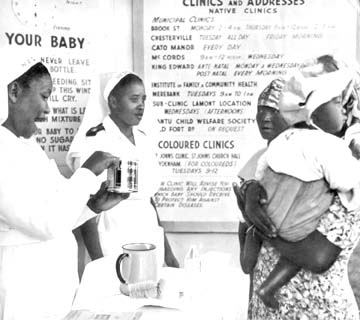
Nestlé famously offered Nelson Mandela half a million pounds in 2003 to try to ingratiate itself with the man who led the battle to over turn apartheid. Nestlé had rejected Mandela's call for foreign companies to disinvest during the apartheid years.
The offer was made by Lord Richard Attenborough surprisingly enough (there was a link to Nestlé through a PR consultant), who said: "They [Nestlé] are so desperate to reinstitute themselves in South Africa, to be seen to have changed their philosophies and that they are now totally in favour of everything he [Mandela] stands for."
All Nestlé wanted in return was a photograph of an executive presenting the cheque direct to former President Mandela and the kudos of it going to his children's charity, a great way to counter Nestlé's appalling image for the impact of its aggressive marketing of baby foods and its exploitation of concerns over HIV and infant feeding. It wasn't the first time it had tried to use its cheque book to improve its image, as Nelson Mandela's Children's Fund pointed out when they said they would refuse the offered half million as they had refused the past offer:
"Given the Nestle debacle in relation to HIV/Aids infected mothers and their campaign on promoting formula milk as opposed to breast milk and the disadvantages they put out publicly regarding breast feeding, the Nelson Mandela Children's Fund declined the donation."
See:
http://www.babymilkaction.org/press/press06march03.html
While Nestlé professes to stick by oppressive regimes for nutritional reasons, its record suggest it is more interested in pushing formula in breach of the World Health Assembly marketing requirements as it puts its own profits before all else.
You can find out more about the campaign in support of democracy in Burma and make a donation to it should you wish to do so at http://www.burmacampaign.org.uk/

This picture from 13 July 2001 shows Business Development Manager Khun Suravath Pinsunwanbutr of Nestle Trading Limited Myanmar Representative Office presenting gifts to the Myanmar Maternal and Child Welfare Association Chairperson of MMCWA Professor Daw Kyu Kyu Swe and Vice-Chairperson Dr Daw Khin Win Shwe (wife of then Chief of Intelligence and later Prime Minister, General Khin Nyunt).
The Global Unions organisations reports that Health Minister Maj-Gen Ket Sein received Nestlé Vice-President Mr Khun Nophadol Siwabutr in 2001, prompting a response from the company - the pdf can be downloaded by clicking here.
Nestlé said it employes three staff in Burma and its business is conducted through a third party.
Nestlé said: "Nestlé does business in nearly all countries in the world, and our products are found in widely diverse political settings. As we provide basic food products, it is recognized that refusing to do business in a country would result in a worsening of the diet and nutritional status of the population. Therefore, we do not refuse to do business in individual countries, but work for social and economic development trhough our business activities."
It is an intersting point and it is worth reiterating that the Nestlé boycott list does not include Nestlé formula because there may be times when it is necessary, but there are two other facts to be taken into account.
Firstly, Burma's pro-democracy movement, led by Nobel Laureate Aung San Suu Kyi, has called on foreign companies to disinvest. While the above event was in 2001 there is no indication the situation has changed and a 2006 report states that Fraser and Neave Holdings is manufacturing other Nestlé products for the Burma/Myanmar market.
Secondly, in the picture at the top the Nestlé executive is donating tins of Lactogen 2 formula. Such donations are a violation of the World Health Assembly marketing requirements Nestlé professes it abides by. Provision of free supplies is one of the strategies Nestlé uses to undermine breastfeeding. As well as donating tins in the ceremony, tins were donated to Yangon Children Hospital, North Okkalapa General Hospital, People's Hospital (East Yangon), People's Hospital (West Yangon), Insein General Hospital, South Okkalapa Women's & Children's Hospital and Thin-gangyun Sanpya General Hospital in a ceremony attended by Minister for Health Maj-Gen Ket Sein, Deputy Ministers Professor Dr Mya Oo and Prof. Dr Kyaw Myint (google archived web page).
Nestlé has a history of supporting oppressive regimes. Here is a picture from the 1950s of its 'milk nurses' providing Nestlé formula to mothers in apartheid South Africa. Providing free formula interupts lactation to make a mother dependent on formula, which she then has to buy.
Nestlé famously offered Nelson Mandela half a million pounds in 2003 to try to ingratiate itself with the man who led the battle to over turn apartheid. Nestlé had rejected Mandela's call for foreign companies to disinvest during the apartheid years.
The offer was made by Lord Richard Attenborough surprisingly enough (there was a link to Nestlé through a PR consultant), who said: "They [Nestlé] are so desperate to reinstitute themselves in South Africa, to be seen to have changed their philosophies and that they are now totally in favour of everything he [Mandela] stands for."
All Nestlé wanted in return was a photograph of an executive presenting the cheque direct to former President Mandela and the kudos of it going to his children's charity, a great way to counter Nestlé's appalling image for the impact of its aggressive marketing of baby foods and its exploitation of concerns over HIV and infant feeding. It wasn't the first time it had tried to use its cheque book to improve its image, as Nelson Mandela's Children's Fund pointed out when they said they would refuse the offered half million as they had refused the past offer:
"Given the Nestle debacle in relation to HIV/Aids infected mothers and their campaign on promoting formula milk as opposed to breast milk and the disadvantages they put out publicly regarding breast feeding, the Nelson Mandela Children's Fund declined the donation."
See:
http://www.babymilkaction.org/press/press06march03.html
While Nestlé professes to stick by oppressive regimes for nutritional reasons, its record suggest it is more interested in pushing formula in breach of the World Health Assembly marketing requirements as it puts its own profits before all else.
You can find out more about the campaign in support of democracy in Burma and make a donation to it should you wish to do so at http://www.burmacampaign.org.uk/
Friday, September 28, 2007
The UK law consultation closes - now will the government act?
It has been a slog, but we have completed our submission to the UK Government's consultation on strengthening the formula marketing regulations and sent it off. It's a 40-page document responding to specific questions and setting out why we and our partners in the Baby Feeding Law Group and Breastfeeding Manifesto coalition want the Government to bring the UK law into line with international standards.
I would like to thank everyone involved for their help with it. In providing reports about baby food company marketing practices to our monitoring project, for expert input, for proof reading, for gaining the official support of your organisation. Just about all health professional and mother support groups are backing the call for implementation of the World Health Assembly marketing requirements in the UK.
Whether the Government will act remains to be seen. Our aim and that of our partners is to protect all mothers and infants, whether breastfeeding or formula-feeding, by ensuring information is accurate and independent, support for mothers for breastfeeding and support for those who use formula to reduce the risks.
Our report is called: Protecting breastfeeding. Protecting babies fed on formula.
 There will be an official launch in due course. You can read the report and obtain a printed copy via the Baby Milk Action website.
Unfortunately, this is only the beginning.
We have to see if the Food Standards Agency will take on board the views of the health experts and implement the international standards. As in every country, it will be up against the lobbying of the baby food industry. And, as I reported earlier this week, our Minister for Public Health was sharing a platform with Nestlé at a Nestlé-sponsored event at the Labour Party Conference. The event was about obesity. Ironically, if the government took action to protect breastfeeding, it would have an impact on obesity. Nestlé is not a big player in the UK formula market - its attempts to break in have gone disasterously wrong. But the companies that are here also have a record of aggression against legislaton that may hamper their growth in sales. For example, Wyeth/SMA is involved in a legal battle in the Philippines to have regulations struck down.
The draft UK regulations put out for consultation were not good. We now have to see what will be presented to the Parliament. Then we will have to campaign to ensure a weak law is strengthened or a strong law is not sabotaged. So much to do. But having worked on the report through the past few weekends, it is time for a rest.
One thing to finish. I had to check one of the statistics I have been using. This came from the Government Infant Feeding Survey 2005, which states : "Nine in ten mothers who gave up breastfeeding within six months would have preferred to breastfeed for longer, this level declining as breastfeeding duration increased. Although even among those who breastfed for at least six months, 40% would have liked to continue longer."
It's on page 221 of the report, but it is wrong as one of the experts working on the submission pointed out.
These are the actual findings in graphical form. This shows the proportion of mothers who stopped breastfeeding who would have liked to breastfeed longer:
 Elsewhere in the report it states 9 out of 10 mothers who stopped breastfeeding by 6 weeks (not months) said they wanted to breastfeed for longer.
All the same, 40% of mothers who breastfed for at least 6 months said they wanted to breastfeed for longer.
Something is wrong if so many mothers are not able to breastfeed for as long as they wish.
Stopping the aggressive formula marketing practices is only the part of the story, of course. Mothers experiencing difficulties with breastfeeding need support.
An integrated approach can work. This is a graph from a Brazilian paper by Dr. Marina Rea, showing how median breastfeeding rates have recovered from less than 3 months in the 1970s to more than 10 months today.
 The text refers to various initiatives to support mothers, including introducing progressively stronger legislation. I've written about this previously at:
http://boycottnestle.blogspot.com/2007/07/breastfeeding-chic.html
When I saw the UK government survey report had this error with the 90% figure, I thought of making a flippant comment about not being able to trust the government.
But we do have to trust they will put infant health and mothers rights first (saving a fortune at the same time) by strengthening the law.
We can set out the evidence. We can campaign - and we will need your help to lobby your Member of Parliament if you are in the UK.
But at the end of the day, it is the politicians who hold the power to decide what is written into legislation.
I would like to thank everyone involved for their help with it. In providing reports about baby food company marketing practices to our monitoring project, for expert input, for proof reading, for gaining the official support of your organisation. Just about all health professional and mother support groups are backing the call for implementation of the World Health Assembly marketing requirements in the UK.
Whether the Government will act remains to be seen. Our aim and that of our partners is to protect all mothers and infants, whether breastfeeding or formula-feeding, by ensuring information is accurate and independent, support for mothers for breastfeeding and support for those who use formula to reduce the risks.
Our report is called: Protecting breastfeeding. Protecting babies fed on formula.
 There will be an official launch in due course. You can read the report and obtain a printed copy via the Baby Milk Action website.
Unfortunately, this is only the beginning.
We have to see if the Food Standards Agency will take on board the views of the health experts and implement the international standards. As in every country, it will be up against the lobbying of the baby food industry. And, as I reported earlier this week, our Minister for Public Health was sharing a platform with Nestlé at a Nestlé-sponsored event at the Labour Party Conference. The event was about obesity. Ironically, if the government took action to protect breastfeeding, it would have an impact on obesity. Nestlé is not a big player in the UK formula market - its attempts to break in have gone disasterously wrong. But the companies that are here also have a record of aggression against legislaton that may hamper their growth in sales. For example, Wyeth/SMA is involved in a legal battle in the Philippines to have regulations struck down.
The draft UK regulations put out for consultation were not good. We now have to see what will be presented to the Parliament. Then we will have to campaign to ensure a weak law is strengthened or a strong law is not sabotaged. So much to do. But having worked on the report through the past few weekends, it is time for a rest.
One thing to finish. I had to check one of the statistics I have been using. This came from the Government Infant Feeding Survey 2005, which states : "Nine in ten mothers who gave up breastfeeding within six months would have preferred to breastfeed for longer, this level declining as breastfeeding duration increased. Although even among those who breastfed for at least six months, 40% would have liked to continue longer."
It's on page 221 of the report, but it is wrong as one of the experts working on the submission pointed out.
These are the actual findings in graphical form. This shows the proportion of mothers who stopped breastfeeding who would have liked to breastfeed longer:
 Elsewhere in the report it states 9 out of 10 mothers who stopped breastfeeding by 6 weeks (not months) said they wanted to breastfeed for longer.
All the same, 40% of mothers who breastfed for at least 6 months said they wanted to breastfeed for longer.
Something is wrong if so many mothers are not able to breastfeed for as long as they wish.
Stopping the aggressive formula marketing practices is only the part of the story, of course. Mothers experiencing difficulties with breastfeeding need support.
An integrated approach can work. This is a graph from a Brazilian paper by Dr. Marina Rea, showing how median breastfeeding rates have recovered from less than 3 months in the 1970s to more than 10 months today.
 The text refers to various initiatives to support mothers, including introducing progressively stronger legislation. I've written about this previously at:
http://boycottnestle.blogspot.com/2007/07/breastfeeding-chic.html
When I saw the UK government survey report had this error with the 90% figure, I thought of making a flippant comment about not being able to trust the government.
But we do have to trust they will put infant health and mothers rights first (saving a fortune at the same time) by strengthening the law.
We can set out the evidence. We can campaign - and we will need your help to lobby your Member of Parliament if you are in the UK.
But at the end of the day, it is the politicians who hold the power to decide what is written into legislation.
Thursday, September 27, 2007
Cow and Gate in Tesco exploiting loopholes in UK legislation
Just look at what Cow & Gate is doing in Tesco supermarkets in the UK!
Though first remember that NUMICO, the transnational corporation behind the Cow & Gate brand, has been told by the Food Standards Agency that only claims permitted by the law can be used on labels of infant formula. The LACORS (Local Authorities Coordinators of Regulatory Services) guidance to Tradng Standards officers states that claims such as "Prebiotics supporting baby's natural defences" are non-compliant with the legislation. See:
http://www.babymilkaction.org/pdfs/lacorsonepage07.pdf
There is also an Advertising Standards Authority ruling against prebiotics claims in a Cow & Gate follow-on milk advertisement which stated: "Our range of follow-on milks all contain a bunch of goodies called prebiotics to help build natural defences. Prebiotics are the special ingredients naturally found in breast milk, which of course is the best form of nutrition you can give your baby. But if you're not breastfeeding, our follow-on milks can still help your baby build strong defences." The evidence provided did not substantiate the claim. See:
http://boycottnestle.blogspot.com/2006/11/one-cheer-for-advertising-standards.html
Okay, so now to the reports we are receiving of Cow & Gate representatives in Tesco supermarkets pushing their formulas at customers, with stands, vouchers and prominent shelf talkers. Here is one:

If you are a regular reader of this blog it will come as now surprise to learn that despite all the above this includes the claim that Cow & Gate is 'with Prebiotic Care to support your baby's natural immune system'.
Is the law in the UK really so toothless? Yes, I'm afraid it is. If you look closely at this shelf talker you will see the small print says 'from 6 months to 3 years'. This enables the company to claim it is for follow-on milks not infant formula - though that is with it on the shelves. The UK law prohibits promotion of infant formula, but allows it for follow-on milks. Although the ASA has ruled against the claim in a follow-on formula advertisement it means nothing to the company.
 The representatives are also handing out and displaying money off coupons with the claim that the formula helps 'support you baby's natural immune system throughout their early years'.
So the law is an ass and the draft revision of it prepared by the Food Standards Agency is little better.
With partners in the Baby Feeding Law Group and Breastfeeding Manifesto coalition, we are calling for the law to be strengthened. The Telegraph newspaper reports on this today. See:
http://www.telegraph.co.uk/news/main.jhtml?xml=/news/2007/09/27/nmilk127.xml
Tomorrow is the deadline for submitting comments. See:
http://www.babymilkaction.org/action/ukaction07.html
Though first remember that NUMICO, the transnational corporation behind the Cow & Gate brand, has been told by the Food Standards Agency that only claims permitted by the law can be used on labels of infant formula. The LACORS (Local Authorities Coordinators of Regulatory Services) guidance to Tradng Standards officers states that claims such as "Prebiotics supporting baby's natural defences" are non-compliant with the legislation. See:
http://www.babymilkaction.org/pdfs/lacorsonepage07.pdf
There is also an Advertising Standards Authority ruling against prebiotics claims in a Cow & Gate follow-on milk advertisement which stated: "Our range of follow-on milks all contain a bunch of goodies called prebiotics to help build natural defences. Prebiotics are the special ingredients naturally found in breast milk, which of course is the best form of nutrition you can give your baby. But if you're not breastfeeding, our follow-on milks can still help your baby build strong defences." The evidence provided did not substantiate the claim. See:
http://boycottnestle.blogspot.com/2006/11/one-cheer-for-advertising-standards.html
Okay, so now to the reports we are receiving of Cow & Gate representatives in Tesco supermarkets pushing their formulas at customers, with stands, vouchers and prominent shelf talkers. Here is one:

If you are a regular reader of this blog it will come as now surprise to learn that despite all the above this includes the claim that Cow & Gate is 'with Prebiotic Care to support your baby's natural immune system'.
Is the law in the UK really so toothless? Yes, I'm afraid it is. If you look closely at this shelf talker you will see the small print says 'from 6 months to 3 years'. This enables the company to claim it is for follow-on milks not infant formula - though that is with it on the shelves. The UK law prohibits promotion of infant formula, but allows it for follow-on milks. Although the ASA has ruled against the claim in a follow-on formula advertisement it means nothing to the company.
 The representatives are also handing out and displaying money off coupons with the claim that the formula helps 'support you baby's natural immune system throughout their early years'.
So the law is an ass and the draft revision of it prepared by the Food Standards Agency is little better.
With partners in the Baby Feeding Law Group and Breastfeeding Manifesto coalition, we are calling for the law to be strengthened. The Telegraph newspaper reports on this today. See:
http://www.telegraph.co.uk/news/main.jhtml?xml=/news/2007/09/27/nmilk127.xml
Tomorrow is the deadline for submitting comments. See:
http://www.babymilkaction.org/action/ukaction07.html
Wednesday, September 26, 2007
Nestle and its cheque book at the Labour Party Conference
Nestlé has been popping up sponsoring events at the Labour Party Conference in Bournemouth, just like last year in Manchester. The approach is all too familiar. Nestlé puts its money into events on topics where it has a Public Relations problem and, unfortunately, people take the money and share a platform with Nestlé as it tries to improve its image. If we aren't there to remind people of the truth about Nestlé activities and, in particular, its aggressive marketing of baby foods and the need to support the boycott, then it gets away with it.
Here's how Nestlé strategy works. Last year Nestlé was due in court in the US as the International Labour Rights Fund brought a legal action over its failure to implement a 5-year plan to erradicate child slavery on the cocoa farms in Ivory Coast that supply it. Nestlé refused to attend a meeting hosted by the Senator who had developed the plan it had signed up to, but was happy to sponsor and attend a public meeting at the Labour Party Conference in the UK about slavery. We did manage to mobilise some leafleters and my colleague, Patti, attended the event to raise questions from the floor. See our press release from the time which links to an audio interview with the Director of the International Labour Rights Fund at:
http://www.babymilkaction.org/press/press28sept06.html
This year, as well as the baby food issue, Nestlé has been trying to shake off criticisms of its unhealthy foods, which are implicated in the epidemic of obesity, and its illegal water extraction in São Lourenço in Brazil.
So guess the theme of the two meetings it has sponsored at this year's Conference?
On Monday it was on obesity with the New Statesman Magazine. See:
http://www.newstatesman.com/conference-events
The Public Health Minister was on the panel and someone raised form the audience raised the question of the current consultation on the UK baby food law and questioned how the government can claim to be independent of the baby food industry.
Today it was on water, hosted by the Foreign Policy Centre, under the title: "Water: how can we better manage our most precious resource?" See the pdf downloadable by clicking:
http://fpc.org.uk/fsblob/869.pdf
I've written here previously about the ten-year campaign to stop Nestlé's illegal exploitation of water in São Lourenço, Brazil. After meeting the water campaigners at other events, we shared our experiences and helped to organised a meeting in the UK in March last year about their efforts to stop the illegal extraction and demineralisation of water from the historic water park. Nestlé's pumping has affected the natural springs and the tourism on which the town depends.
In 2005 I visited São Lourenço and spoke to the Public Prosecutor who had taken Nestlé to court after the citizens of the town raised a petition. Under the legal system he had to investigate the allegations in the petition and, finding a case to answer, had filed what is called a civil public action. I also met the Congressman, Dr. Rosinha, in Brasilia who had organised a public hearing into Nestlé's operations and found they not only contravened Federal Law, but their attempted justification for continued pumping was totally invalid.
I compiled documents, including a legal opinion from a Federal Prosecutor which again found the activities were against the law and suggested an investigation into possible corruption amongst officials who had allowed it to continue. I also spoke with a hydrologist in the park and collated official test results and investigations into what had happened. This evidence can be made available for journalists and others in the UK interested in this case.
Finally, earlier this year, the Public Prosecutor and Nestlé signed an agreement that pumping had to stop and the park be renovated otherwise Nestlé would be liable for daily fines. Recently pumping did indeed stop, over ten years after it began. Nestlé is now the world's biggest bottled water company and there are similar complaints about its treatment of communities and the environmental impact of its activities in other countries. Including the UK (see the 2005 news report here).
There wasn't time for my colleague Patti Rundall in the fringe meeting audience to raise all this today, but she did question Nestlé's presence there when it is the target of the boycott over its baby food marketing, its illegal water activities and the fact that its own audit, conducted by Bureau Veritas, was being used by Nestlé when it so blatantly failed to give the facts. Nestlé refers to the Bureau Veritas audit in a Public Relations publication on its activities in Latin America. See:
http://www.babymilkaction.org/press/press2march06.html
That press release links to supporting documents substantiating the allegations against Nestlé.
Nestlé's Hilary Parsons was on the panel and came out with various claims that she knows to be untrue, saying Nestlé abides by the baby food marketing requirements and that it had done nothing wrong in São Lourenço, citing the Bureau Veritas audit.
I have discussed the audit with the Bureau Veritas investigators. My view is they were either incompetent or part of the misrepresentation of the facts. When I encountered them at the launch of Nestlé's PR report on Latin America they seemed to be unaware of the civil public action, despite having visited São Lourenço and being shown around by Nestlé. Eventually Bureau Veritas admitted: "our work did not constitute a legal audit as such, nor did it include a review of the on-going civil action".
Nestlé's use of a report produced by auditors who apparently didn't even know it was fighting a legal battle over its operations shows just how duplicitous the company is.
You can see some of the evidence yourself by following the links from the press release referred to above. Here's a flavour - the map showing a new wall and expanded bottling plant was built in an area of maximum environmental vulnerability, for which Nestlé did not have permission.

You can also read the transcript of a radio programme recorded by the BBC and broadcast in 2005, and listen to it on line. See:
http://www.bbc.co.uk/radio4/facethefacts/transcript_20050722.shtml
Those who have taken Nestlé's money for these fringe events and shared a platform with it as it boasts of its 'good works' and brushes aside criticism are in a poor position to hold it to account. They are unlikely to be familiar enough with the evidence to respond to the demonstrably untrue claims made by Nestlé and they would appear rude and ungrateful if they did.
I wish they would think a little more about how they appear involving themselves in Nestlé Public Relations strategy in this way.
For Nestlé it is money well spent. Nestlé loves the image transfer it gains from such events. No doubt, its cheque book is at the ready to book up events for next year.
Here's how Nestlé strategy works. Last year Nestlé was due in court in the US as the International Labour Rights Fund brought a legal action over its failure to implement a 5-year plan to erradicate child slavery on the cocoa farms in Ivory Coast that supply it. Nestlé refused to attend a meeting hosted by the Senator who had developed the plan it had signed up to, but was happy to sponsor and attend a public meeting at the Labour Party Conference in the UK about slavery. We did manage to mobilise some leafleters and my colleague, Patti, attended the event to raise questions from the floor. See our press release from the time which links to an audio interview with the Director of the International Labour Rights Fund at:
http://www.babymilkaction.org/press/press28sept06.html
This year, as well as the baby food issue, Nestlé has been trying to shake off criticisms of its unhealthy foods, which are implicated in the epidemic of obesity, and its illegal water extraction in São Lourenço in Brazil.
So guess the theme of the two meetings it has sponsored at this year's Conference?
On Monday it was on obesity with the New Statesman Magazine. See:
http://www.newstatesman.com/conference-events
The Public Health Minister was on the panel and someone raised form the audience raised the question of the current consultation on the UK baby food law and questioned how the government can claim to be independent of the baby food industry.
Today it was on water, hosted by the Foreign Policy Centre, under the title: "Water: how can we better manage our most precious resource?" See the pdf downloadable by clicking:
http://fpc.org.uk/fsblob/869.pdf
I've written here previously about the ten-year campaign to stop Nestlé's illegal exploitation of water in São Lourenço, Brazil. After meeting the water campaigners at other events, we shared our experiences and helped to organised a meeting in the UK in March last year about their efforts to stop the illegal extraction and demineralisation of water from the historic water park. Nestlé's pumping has affected the natural springs and the tourism on which the town depends.
In 2005 I visited São Lourenço and spoke to the Public Prosecutor who had taken Nestlé to court after the citizens of the town raised a petition. Under the legal system he had to investigate the allegations in the petition and, finding a case to answer, had filed what is called a civil public action. I also met the Congressman, Dr. Rosinha, in Brasilia who had organised a public hearing into Nestlé's operations and found they not only contravened Federal Law, but their attempted justification for continued pumping was totally invalid.
I compiled documents, including a legal opinion from a Federal Prosecutor which again found the activities were against the law and suggested an investigation into possible corruption amongst officials who had allowed it to continue. I also spoke with a hydrologist in the park and collated official test results and investigations into what had happened. This evidence can be made available for journalists and others in the UK interested in this case.
Finally, earlier this year, the Public Prosecutor and Nestlé signed an agreement that pumping had to stop and the park be renovated otherwise Nestlé would be liable for daily fines. Recently pumping did indeed stop, over ten years after it began. Nestlé is now the world's biggest bottled water company and there are similar complaints about its treatment of communities and the environmental impact of its activities in other countries. Including the UK (see the 2005 news report here).
There wasn't time for my colleague Patti Rundall in the fringe meeting audience to raise all this today, but she did question Nestlé's presence there when it is the target of the boycott over its baby food marketing, its illegal water activities and the fact that its own audit, conducted by Bureau Veritas, was being used by Nestlé when it so blatantly failed to give the facts. Nestlé refers to the Bureau Veritas audit in a Public Relations publication on its activities in Latin America. See:
http://www.babymilkaction.org/press/press2march06.html
That press release links to supporting documents substantiating the allegations against Nestlé.
Nestlé's Hilary Parsons was on the panel and came out with various claims that she knows to be untrue, saying Nestlé abides by the baby food marketing requirements and that it had done nothing wrong in São Lourenço, citing the Bureau Veritas audit.
I have discussed the audit with the Bureau Veritas investigators. My view is they were either incompetent or part of the misrepresentation of the facts. When I encountered them at the launch of Nestlé's PR report on Latin America they seemed to be unaware of the civil public action, despite having visited São Lourenço and being shown around by Nestlé. Eventually Bureau Veritas admitted: "our work did not constitute a legal audit as such, nor did it include a review of the on-going civil action".
Nestlé's use of a report produced by auditors who apparently didn't even know it was fighting a legal battle over its operations shows just how duplicitous the company is.
You can see some of the evidence yourself by following the links from the press release referred to above. Here's a flavour - the map showing a new wall and expanded bottling plant was built in an area of maximum environmental vulnerability, for which Nestlé did not have permission.

You can also read the transcript of a radio programme recorded by the BBC and broadcast in 2005, and listen to it on line. See:
http://www.bbc.co.uk/radio4/facethefacts/transcript_20050722.shtml
Those who have taken Nestlé's money for these fringe events and shared a platform with it as it boasts of its 'good works' and brushes aside criticism are in a poor position to hold it to account. They are unlikely to be familiar enough with the evidence to respond to the demonstrably untrue claims made by Nestlé and they would appear rude and ungrateful if they did.
I wish they would think a little more about how they appear involving themselves in Nestlé Public Relations strategy in this way.
For Nestlé it is money well spent. Nestlé loves the image transfer it gains from such events. No doubt, its cheque book is at the ready to book up events for next year.
Tuesday, September 25, 2007
Health oranisations call for the UK Government to implement formula marketing standards
UK health organisations have had a letter published in The Times today calling for the Government to implement the World Health Assembly marketing requirements for baby foods.
It is a broad coalition, including Baby Milk Action (which is the secretariat for the Baby Feeding Law Group), the Breastfeeding Manifesto Coalition and individual members of these coalitions: Midwives Information & Resource Services, National Childbirth Trust, Save the Children and Unicef UK and the Mother and Infant Research Unit, University of York.
We are calling for the Government to implement the International Code of Marketing of Breastmilk Substitutes (which should be read together with the subsequent, relevant Resolutions of the Assembly which address changes in scientific knowledge and marketing practices and questions of interpretation).
This includes a ban on advertising and other forms of promotion of breastmilk substitutes. It is for health workers to provide accurate and independent information to parents and carers.
It also includes the right to accurate and independent information on use of formula for parents and carers who use it.
The consultation period comes to an end on Friday. See:
http://www.babymilkaction.org/action/ukaction07.html
It is a broad coalition, including Baby Milk Action (which is the secretariat for the Baby Feeding Law Group), the Breastfeeding Manifesto Coalition and individual members of these coalitions: Midwives Information & Resource Services, National Childbirth Trust, Save the Children and Unicef UK and the Mother and Infant Research Unit, University of York.
We are calling for the Government to implement the International Code of Marketing of Breastmilk Substitutes (which should be read together with the subsequent, relevant Resolutions of the Assembly which address changes in scientific knowledge and marketing practices and questions of interpretation).
This includes a ban on advertising and other forms of promotion of breastmilk substitutes. It is for health workers to provide accurate and independent information to parents and carers.
It also includes the right to accurate and independent information on use of formula for parents and carers who use it.
The consultation period comes to an end on Friday. See:
http://www.babymilkaction.org/action/ukaction07.html
Monday, September 24, 2007
Will the new Nestle boss be the same as the old Nestle boss?
Nestlé is going to have a new Chief Executive Officer. Will it make any difference? Let's hope so, but first some background.
There was a great deal of controversy in 2005 when Chief Executive Officer, Peter Brabeck-Letmathé, had himself declared Chairman of the Board of Directors as well. A shareholder rebellion over this outright breaking of corporate-governance best practice got only 36% of the vote.
Shareholder democracy is compromised as Nestlé makes it difficult for share owners to register their shares. Indeed, so few are registered that it makes it statistically impossible to change some aspects of the articles of association of the company. Nestlé refused to let me register my one share, which the broker I used found unusual. It meant I couldn’t use it as intended to attend the shareholder meeting and had to go by other means. Nestlé claims that more than a third 'have elected' not to register their shares, meaning the two-thirds majority required for some changes is impossible.
There is a further obstacle to holding Nestlé to account through shareholder democracy. As I reported in April, it was a shock to see how shareholders hissed and booed anyone standing up to question Mr. Brabeck’s management practices. See:
http://boycottnestle.blogspot.com/2007/04/glimpse-of-nestls-soul.html
With even institutional investors voicing concern when Mr. Brabeck's wanted to take on a dual role, only a third of votes represented at the shareholder meeting could be mustered. In an attempt to show sensitivity to shareholder concerns, however, Mr. Brabeck said he would stand down and Chief Executive in 2008, with his successor being identified in September 2007.
That process has now completed. And the winner is….
Mr. Paul Bulcke, currently Executive Vice President and Zone Director for United States of America, Canada, Latin America, Caribbean.
He is not yet a member of the Board. The Board is proposing that he be elected and appointed Chief Executive at the shareholder meeting in April 2008. This is being treated by Nestlé as a done deal and Mr. Bulcke will shortly begin the process of restructuring the Executive Board as CEO-designate.
So will Mr. Bulcke be any different from Mr. Brabeck when it comes to respecting the World Health Assembly marketing requirements for baby foods (or any of the other issues where Mr. Brabeck has attracted criticism and charges of abusing human rights and the environment)?
Well, we will give him a chance and ask him to accept the four-point plan aimed at saving infant lives and ultimately ending the international boycott. Mr. Brabeck rejected the plan and also rejected an invitation to attend an independent expert tribunal where he would have had the opportunity to show whether the claim that Nestlé markets infant formula ethically and responsibly is true. His reluctance to attend the tribunal is perhaps not surprising, as he knows we can demonstrate the claim is not true. Indeed, we have already done so before the UK Advertising Standards Authority after Nestlé made the claim in an anti-boycott advertisement.
Whether Mr. Bulcke will continue the strategy of denials and deception pursued by Mr. Brabeck in a failed attempt to undermine the boycott, while continuing with aggressive baby food marketing practices, remains to be seen. Nestlé’s Global Public Affairs Manager, Gayle Crozier Willi, admitted earlier this year that Nestlé is ‘widely boycotted’ so perhaps a new leader will face up to this and respond to the four-point plan.
Mr. Brabeck’s regime has been beset with public relations disasters on the boycott, from the ruling against the anti-boycott advertisement and his response to it (which generated headlines like “Mr. Nestlé gets angry") and his big book of letters from governments (which it turned out was not all it seemed). Perhaps his unsafe pair of hands when it comes to responding to the boycott will not be missed. See
http://boycottnestle.blogspot.com/2006/11/nestl-chief-executive-should-relax.html
Mr. Brabeck has been successful in delivering on the so-called Nestlé model. This involves aggressively pursuing growth in sales and unceremoniously dumping any business which does not achieve 5-6% annual growth.
This is where the signals about what to expect from Mr. Bulcke do not look good. As head of Latin America he has been successful in exceeding this growth target, with infant nutrition being one of the key growth areas.
He is already on the record saying that the recent acquisition of Gerber baby foods will be a motor for growth. As we exposed last year, Gerber violates the World Health Assembly marketing requirements in a systematic manner and there is little hope of this changing if it is fundamental to growth plans.
Mr. Bulcke has also stated that he sees China and India as key growth markets. The company has a poor record in both when it comes to baby food marketing. In China, for example, it provoked a boycott for refusing to remove from sale formula with levels of iodine outside permitted levels and then tried to recover its image by putting health workers into supermarkets in ‘nutrition corners’ where pregnant and lactating women were targeted. In India it has targeted medical students and workers with sponsorship in breach of national legislation and has distributed promotional leaflets to parents. See past reports in our Campaign for Ethical Marketing.
Will the new boss be the same as the old boss?
It remains to be seen. But Mr. Brabeck will remain the Chairman of the Board so setting strategic direction, which can't be good.
Some years ago, before he became Chairman, we wrote to all board members asking them to investigate Mr. Brabeck’s baby food marketing policies. We did not receive one reply. Since he became Chairman there has been little point complaining to him about himself and there will be little point complaining to him if Mr. Bulcke follows the same approach of putting profits before infant health and the rights of mothers.
All the same, we will write to Mr. Bulcke when he takes up his post and would like to raise questions at the shareholder meeting, if possible. Why not buy a share yourself and come along, or send us a donation to help us attend. See:
http://boycottnestle.blogspot.com/2007/04/got-any-nestl-shares.html
There was a great deal of controversy in 2005 when Chief Executive Officer, Peter Brabeck-Letmathé, had himself declared Chairman of the Board of Directors as well. A shareholder rebellion over this outright breaking of corporate-governance best practice got only 36% of the vote.
Shareholder democracy is compromised as Nestlé makes it difficult for share owners to register their shares. Indeed, so few are registered that it makes it statistically impossible to change some aspects of the articles of association of the company. Nestlé refused to let me register my one share, which the broker I used found unusual. It meant I couldn’t use it as intended to attend the shareholder meeting and had to go by other means. Nestlé claims that more than a third 'have elected' not to register their shares, meaning the two-thirds majority required for some changes is impossible.
There is a further obstacle to holding Nestlé to account through shareholder democracy. As I reported in April, it was a shock to see how shareholders hissed and booed anyone standing up to question Mr. Brabeck’s management practices. See:
http://boycottnestle.blogspot.com/2007/04/glimpse-of-nestls-soul.html
With even institutional investors voicing concern when Mr. Brabeck's wanted to take on a dual role, only a third of votes represented at the shareholder meeting could be mustered. In an attempt to show sensitivity to shareholder concerns, however, Mr. Brabeck said he would stand down and Chief Executive in 2008, with his successor being identified in September 2007.
That process has now completed. And the winner is….
Mr. Paul Bulcke, currently Executive Vice President and Zone Director for United States of America, Canada, Latin America, Caribbean.
He is not yet a member of the Board. The Board is proposing that he be elected and appointed Chief Executive at the shareholder meeting in April 2008. This is being treated by Nestlé as a done deal and Mr. Bulcke will shortly begin the process of restructuring the Executive Board as CEO-designate.
So will Mr. Bulcke be any different from Mr. Brabeck when it comes to respecting the World Health Assembly marketing requirements for baby foods (or any of the other issues where Mr. Brabeck has attracted criticism and charges of abusing human rights and the environment)?
Well, we will give him a chance and ask him to accept the four-point plan aimed at saving infant lives and ultimately ending the international boycott. Mr. Brabeck rejected the plan and also rejected an invitation to attend an independent expert tribunal where he would have had the opportunity to show whether the claim that Nestlé markets infant formula ethically and responsibly is true. His reluctance to attend the tribunal is perhaps not surprising, as he knows we can demonstrate the claim is not true. Indeed, we have already done so before the UK Advertising Standards Authority after Nestlé made the claim in an anti-boycott advertisement.
Whether Mr. Bulcke will continue the strategy of denials and deception pursued by Mr. Brabeck in a failed attempt to undermine the boycott, while continuing with aggressive baby food marketing practices, remains to be seen. Nestlé’s Global Public Affairs Manager, Gayle Crozier Willi, admitted earlier this year that Nestlé is ‘widely boycotted’ so perhaps a new leader will face up to this and respond to the four-point plan.
Mr. Brabeck’s regime has been beset with public relations disasters on the boycott, from the ruling against the anti-boycott advertisement and his response to it (which generated headlines like “Mr. Nestlé gets angry") and his big book of letters from governments (which it turned out was not all it seemed). Perhaps his unsafe pair of hands when it comes to responding to the boycott will not be missed. See
http://boycottnestle.blogspot.com/2006/11/nestl-chief-executive-should-relax.html
Mr. Brabeck has been successful in delivering on the so-called Nestlé model. This involves aggressively pursuing growth in sales and unceremoniously dumping any business which does not achieve 5-6% annual growth.
This is where the signals about what to expect from Mr. Bulcke do not look good. As head of Latin America he has been successful in exceeding this growth target, with infant nutrition being one of the key growth areas.
He is already on the record saying that the recent acquisition of Gerber baby foods will be a motor for growth. As we exposed last year, Gerber violates the World Health Assembly marketing requirements in a systematic manner and there is little hope of this changing if it is fundamental to growth plans.
Mr. Bulcke has also stated that he sees China and India as key growth markets. The company has a poor record in both when it comes to baby food marketing. In China, for example, it provoked a boycott for refusing to remove from sale formula with levels of iodine outside permitted levels and then tried to recover its image by putting health workers into supermarkets in ‘nutrition corners’ where pregnant and lactating women were targeted. In India it has targeted medical students and workers with sponsorship in breach of national legislation and has distributed promotional leaflets to parents. See past reports in our Campaign for Ethical Marketing.
Will the new boss be the same as the old boss?
It remains to be seen. But Mr. Brabeck will remain the Chairman of the Board so setting strategic direction, which can't be good.
Some years ago, before he became Chairman, we wrote to all board members asking them to investigate Mr. Brabeck’s baby food marketing policies. We did not receive one reply. Since he became Chairman there has been little point complaining to him about himself and there will be little point complaining to him if Mr. Bulcke follows the same approach of putting profits before infant health and the rights of mothers.
All the same, we will write to Mr. Bulcke when he takes up his post and would like to raise questions at the shareholder meeting, if possible. Why not buy a share yourself and come along, or send us a donation to help us attend. See:
http://boycottnestle.blogspot.com/2007/04/got-any-nestl-shares.html
Friday, September 21, 2007
How Gordon Brown could save billions of pounds by protecting mothers and babies
Gordon Brown could save the UK economy billions of pounds by showing political leadership in the area of infant feeding. That’s the indication from a study in the United States, UK Government surveys and other information. Yet this fact is ignored in the draft Regulatory Impact Assessment produced by the Food Standards Agency as part of the consultation on revising formula marketing regulations. We are calling for the FSA to do a few sums.
According to the UK Government’s national infant feeding survey (page 221), 90% of mothers who stopped breastfeeding by 6 months said they had wanted to breastfeed for longer. If obstacles were removed and better support given, then we could expect them to have their wish. Breastfeeding rates are higher in almost all European countries, markedly so in Scandinavia where the aggressive marketing of formula that occurs in the UK is absent. In Brazil breastfeeding rates have recovered from median duration of less than 3 months to ten months because of government action.
According to the UK Department of Health, breastfed infants are less likely to develop gastric, respiratory and urinary tract infections, obesity in later childhood, juvenile-onset insulin-dependent diabetes and atopic disease.
And as I have been hearing at the International Milk Bank Conference in Chester these past two days, premature infants receiving breastmilk (either from their mother or donor milk from a bank, should they be fortunate to have that opportunity in our current postcode lottery of coverage) are less likely to develop Necrotising Enterocolitis and less likely to die from it if they do develop it.
This reduction in illness and death equates not only to less suffering, but savings for the economy.
A paper cited by the UNICEF Baby Friendly Hospital training for policy makers (Powerpoint presentation) states the following:
---Extract begins
This preliminary analysis of breastfeeding and formula feeding indicates that a minimum of $3.6 billion would be saved if the prevalence of exclusive breastfeeding increased from current rates (64 percent in-hospital, 29 percent at 6 months) to those recommended by the Surgeon General (75 and 50 percent, respectively).
This figure reflects approximately $3.1 billion attributable to preventing premature deaths, and an additional $0.5 billion annual savings associated with reducing traditional medical expenditures (for example, office or hospital visits, laboratory tests, etc.) and indirect costs such as forgone earnings of parents, among others.
This figure probably underestimates the total savings likely. This figure represents only cost savings due to reduced costs to treat three childhood illness; it excludes the cost of purchases for over-the-counter medications for treatment of OM and gastroenteritis symptoms, physician charges related to the treatment of NEC, and cost savings due to reductions in long-term morbidity.
---extract ends
Ref: Weimer. The economic benefits of breastfeeding: A review and analysis, Food Assistance & Nutrition Research Report No. 13. Wash.D.C., USDA, 2001.
As it says, this is probably an underestimate because only the costs of treating three illnesses in the first year are considered. As infants who are not breastfed are more likely to be sick in the longer term, these treatment costs could also be reduced.
Another factor missing from the equation is the treatment costs due to companies not providing preparation instructions in line with Food Standards Agency and World Health Organisation guidance for parents. Powdered infant formula is not sterile, but only one company in the UK warns parents of this fact (Hipp) and it directly contradicts the expert advice on how to reduce the risks of possible contamination. If companies were forced to provide correct information to parents who use formula, as we are demanding, then there could be a reduction in illness attributable to intrinsic contamination of powdered formula with Enterobacter Sakazakii, Salmonella and other pathogens, which is worryingly common (Enterobacter Sakazakii contamination was found in 14% of tins in a survey referenced by the US Food and Drug Administration). Fortunately the steps required to reduce the risks are simple. Unfortunately the industry is loathe to say anything about the risks associated with formula feeding and so does not communicate this. See:
http://www.babymilkaction.org/press/press10aug07.html
If we scale the U$3.6 billion possible savings cited in the US study by the differences in population to gain a crude indication of possible savings for the UK, we arrive at a figure of £360 million for each year of breastfeeding rates at a higher level. A more accurate figure could be arrived at by comparing the assumptions in the paper with the UK situation.
Gordon Brown built his political reputation through being a ‘prudent’ Chancellor of Exchequer. Let us hope he will demand the Food Standards Agency conduct a proper cost-benefit analysis of bringing World Health Assembly marketing requirements into UK law so the enormous potential financial benefit is offset against any fears the government may have to spend a bit of money on lawyers to see off any challenge from the baby food industry wanting to continue aggressive marketing.
According to the UK Government’s national infant feeding survey (page 221), 90% of mothers who stopped breastfeeding by 6 months said they had wanted to breastfeed for longer. If obstacles were removed and better support given, then we could expect them to have their wish. Breastfeeding rates are higher in almost all European countries, markedly so in Scandinavia where the aggressive marketing of formula that occurs in the UK is absent. In Brazil breastfeeding rates have recovered from median duration of less than 3 months to ten months because of government action.
According to the UK Department of Health, breastfed infants are less likely to develop gastric, respiratory and urinary tract infections, obesity in later childhood, juvenile-onset insulin-dependent diabetes and atopic disease.
And as I have been hearing at the International Milk Bank Conference in Chester these past two days, premature infants receiving breastmilk (either from their mother or donor milk from a bank, should they be fortunate to have that opportunity in our current postcode lottery of coverage) are less likely to develop Necrotising Enterocolitis and less likely to die from it if they do develop it.
This reduction in illness and death equates not only to less suffering, but savings for the economy.
A paper cited by the UNICEF Baby Friendly Hospital training for policy makers (Powerpoint presentation) states the following:
---Extract begins
This preliminary analysis of breastfeeding and formula feeding indicates that a minimum of $3.6 billion would be saved if the prevalence of exclusive breastfeeding increased from current rates (64 percent in-hospital, 29 percent at 6 months) to those recommended by the Surgeon General (75 and 50 percent, respectively).
This figure reflects approximately $3.1 billion attributable to preventing premature deaths, and an additional $0.5 billion annual savings associated with reducing traditional medical expenditures (for example, office or hospital visits, laboratory tests, etc.) and indirect costs such as forgone earnings of parents, among others.
This figure probably underestimates the total savings likely. This figure represents only cost savings due to reduced costs to treat three childhood illness; it excludes the cost of purchases for over-the-counter medications for treatment of OM and gastroenteritis symptoms, physician charges related to the treatment of NEC, and cost savings due to reductions in long-term morbidity.
---extract ends
Ref: Weimer. The economic benefits of breastfeeding: A review and analysis, Food Assistance & Nutrition Research Report No. 13. Wash.D.C., USDA, 2001.
As it says, this is probably an underestimate because only the costs of treating three illnesses in the first year are considered. As infants who are not breastfed are more likely to be sick in the longer term, these treatment costs could also be reduced.
Another factor missing from the equation is the treatment costs due to companies not providing preparation instructions in line with Food Standards Agency and World Health Organisation guidance for parents. Powdered infant formula is not sterile, but only one company in the UK warns parents of this fact (Hipp) and it directly contradicts the expert advice on how to reduce the risks of possible contamination. If companies were forced to provide correct information to parents who use formula, as we are demanding, then there could be a reduction in illness attributable to intrinsic contamination of powdered formula with Enterobacter Sakazakii, Salmonella and other pathogens, which is worryingly common (Enterobacter Sakazakii contamination was found in 14% of tins in a survey referenced by the US Food and Drug Administration). Fortunately the steps required to reduce the risks are simple. Unfortunately the industry is loathe to say anything about the risks associated with formula feeding and so does not communicate this. See:
http://www.babymilkaction.org/press/press10aug07.html
If we scale the U$3.6 billion possible savings cited in the US study by the differences in population to gain a crude indication of possible savings for the UK, we arrive at a figure of £360 million for each year of breastfeeding rates at a higher level. A more accurate figure could be arrived at by comparing the assumptions in the paper with the UK situation.
Gordon Brown built his political reputation through being a ‘prudent’ Chancellor of Exchequer. Let us hope he will demand the Food Standards Agency conduct a proper cost-benefit analysis of bringing World Health Assembly marketing requirements into UK law so the enormous potential financial benefit is offset against any fears the government may have to spend a bit of money on lawyers to see off any challenge from the baby food industry wanting to continue aggressive marketing.
Thursday, September 20, 2007
Safer formula campaign on Facebook
Those familiar with the World Health Assembly baby food marketing requirements that we monitor companies against and call for governments to enforce have the aim: "to contribute to the provision of safe and adequate nutrition for infants, by the protection and promotion of breastfeeding, and by ensuring the proper use of breastmilk substitutes, when these are necessary, on the basis of adequate information and through appropriate marketing and distribution.
I've written previously how this sometimes is missed in media coverage of our work, which can end up with a call for regulation of baby food companies being portrayed as an attack on mothers who use formula. See my blog on learning from the furore over the Wyeth/SMA promotion in OK! magazine linked to the celebrity Jordan at:
http://boycottnestle.blogspot.com/2007/08/learning-from-jordan.html
I said then that our call for accurate, independent information is to benefit mothers who use formula, for whatever reason, as well as to protect breastfeeding. Given the heat that can arise in discussions, we have launched a 'safer formula' campaign which we are inviting those who use formula to support and sign up to for updates on what is going on.
There are various blog entries here that are tagged with the 'safer formula', which can be called up by selecting the link at the side panel or the bottom of this entry.
I've added a separate Baby Milk Action group onto Facebook for those interested in keeping updated and discussing this aspect of our work, which can be accessed at:
http://www.facebook.com/group.php?gid=4868284577
Here is the description for it:
---
Baby Milk Action is a not-for-profit organisation that works to protect breastfeeding and to ensure breastmilk substitutes are used safely if necessary.
It is a mother's decision how to feed her child and she has a right to accurate, independent information free from commercial pressure, in line with marketing standards adopted by the World Health Assembly.
We monitor companies and work for the WHA measures to be implemented in legislation and enforced.
We attend the Codex Alimentarius Commission which sets composition and labelling standards for infant formula and other baby foods.
We and our partners campaign for companies to make permanent price cuts to what they charge for formula - it is one of the products with the highest mark ups. In Italy an illegal price-fixing cartel was broken by government action.
We campaign for governments to improve independent sources of information on formula. Monitoring shows that companies do not provide objective information on their products. Nor is their information and instructions on preparation in line with World Health Organisation guidance to parents.
You can find information on our work to make formula-feeding safer at:
http://www.babymilkaction.org/action/saferformula.html
This group is intended for parents and carers who use formula and for health workers and provides links to where to find independent information and our campaigns.
Search for Baby Milk Action for our group on wider aspects of our work, such as protecting breastfeeding and the Nestlé boycott.
---
I've written previously how this sometimes is missed in media coverage of our work, which can end up with a call for regulation of baby food companies being portrayed as an attack on mothers who use formula. See my blog on learning from the furore over the Wyeth/SMA promotion in OK! magazine linked to the celebrity Jordan at:
http://boycottnestle.blogspot.com/2007/08/learning-from-jordan.html
I said then that our call for accurate, independent information is to benefit mothers who use formula, for whatever reason, as well as to protect breastfeeding. Given the heat that can arise in discussions, we have launched a 'safer formula' campaign which we are inviting those who use formula to support and sign up to for updates on what is going on.
There are various blog entries here that are tagged with the 'safer formula', which can be called up by selecting the link at the side panel or the bottom of this entry.
I've added a separate Baby Milk Action group onto Facebook for those interested in keeping updated and discussing this aspect of our work, which can be accessed at:
http://www.facebook.com/group.php?gid=4868284577
Here is the description for it:
---
Baby Milk Action is a not-for-profit organisation that works to protect breastfeeding and to ensure breastmilk substitutes are used safely if necessary.
It is a mother's decision how to feed her child and she has a right to accurate, independent information free from commercial pressure, in line with marketing standards adopted by the World Health Assembly.
We monitor companies and work for the WHA measures to be implemented in legislation and enforced.
We attend the Codex Alimentarius Commission which sets composition and labelling standards for infant formula and other baby foods.
We and our partners campaign for companies to make permanent price cuts to what they charge for formula - it is one of the products with the highest mark ups. In Italy an illegal price-fixing cartel was broken by government action.
We campaign for governments to improve independent sources of information on formula. Monitoring shows that companies do not provide objective information on their products. Nor is their information and instructions on preparation in line with World Health Organisation guidance to parents.
You can find information on our work to make formula-feeding safer at:
http://www.babymilkaction.
This group is intended for parents and carers who use formula and for health workers and provides links to where to find independent information and our campaigns.
Search for Baby Milk Action for our group on wider aspects of our work, such as protecting breastfeeding and the Nestlé boycott.
---
Wednesday, September 19, 2007
Nestle-free shopping trip
A break from the heavy stuff today to post some pictures to promote our new, reusable, Fairtrade-cotton shopping bags out and about around Cambridge.
If you have pictures of our merchandise in action and would like them to appear on our Baby Milk Action Virtual Shop comments blog, please send them to me.


Some new merchandise is in the pipeline. We are thinking baby bibs and adult aprons. What do you think? What images or slogans would you prefer?
Merchandise income helps to keep us operating and independent.
If you have pictures of our merchandise in action and would like them to appear on our Baby Milk Action Virtual Shop comments blog, please send them to me.


Some new merchandise is in the pipeline. We are thinking baby bibs and adult aprons. What do you think? What images or slogans would you prefer?
Merchandise income helps to keep us operating and independent.
Tuesday, September 18, 2007
Infant feeding, type-1 diabetes and a patent for a new-improved formula
I wrote yesterday about the coming strategy of marketing infant formula with an insulin supplement as 'closer to breastmilk', with the claim it could reduce the higher incidence of diabetes in formula-fed infants. See:
http://boycottnestle.blogspot.com/2007/09/insulin-missing-from-formula.html
Infants who are not breastfed, for whatever reason, are at greater risk of short and long-term illness and we want to see those risks reduced. We have been working on this for years - as well as protecting breastfeeding - and recently launched a 'making formula safer' campaign to make it clearer that the regulations we want to see implemented and enforced are there to protect all mothers and babies.
Our main focus at the moment is on responding to a UK government consultation on proposed regulations for the marketing of formula. As they stand, these would allow companies to introduce new ingredients into formula and launch them onto the market without seeking any approval, without registering any evidence on the safety or need for the new ingredients, without any independent review of evidence and without an independent monitoring system for health workers and others to report concerns. All companies will have to do is present a model label of their new product to the Food Standards Agency. In theory they have to have studies that demonstrate the safety of the ingredients, but there is no requirement to present this or for the ingredients to be approved before being put on the market. You can help us achieve better controls by supporting our safer formula campaign and our work (why not become a member of Baby Milk Action?)
The forthcoming added-insulin formulas I wrote about yesterday have prompted me to do a little more digging for this blog.
The patent awarded to the company and Dr. Naim Shehadeh (who appeared in the media report cited yesterday) for the proposed formula is No. 6399090. You can find it here:
http://www.patentstorm.us/patents/6399090-fulltext.html
In presenting the possible benefits of the invention, this states: "exposure to bovine insulin present in fresh cow milk, which differs from human insulin only by three amino acids, may break the tolerance to insulin and lead to autoimmune diabetes."
Autoimmune diabetes or type-1 diabetes is also known as insulin-dependent diabetes mellitus (IDDM). This is where the pancreas is damaged and so cannot produce the insulin needed to control blood sugar levels. Damage may occur due to a virus or it can be because the immune system attacks the cells in the pancreas. This type of diabetes can affect children.
The other type of diabetes, type-2 or non insulin-dependent diabetes (NIDDM), is more common and is associated with adults and their lifestyles.
Both are on the increase. The annual conference of Diabetes UK earlier this year heard about a new study on the increase of type-1 diabetes, as reported by the BBC. See:
http://news.bbc.co.uk/1/hi/health/6455653.stm
---Extract begins
Lead researcher Professor Polly Bingley said the rate of childhood Type 1 diabetes was increasing all over Europe, particularly in the very young.
She said the increase was too steep to be put down to genetic factors alone.
"So it must be due to changes in our environment.
"This could either mean that we are being exposed to something new, or that we now have reduced exposure to something that was previously controlling our immune responses."
She suggested that fewer mums opting to breastfeed their babies might be a factor.
Another possibility is that children are being exposed to fewer germs, affecting the development of their immune systems.
---extract ends
Dr. Shehadeh's patent suggests that exposure to bovine insulin in cow's milk, the primary ingredient of most infant formula, may provoke an immune response in the child. In other words, the suggestion is the child's body sees the bovine insulin as an infection and produces antibodies to attack it. This reaction may prompt the immune system to go on to attack insulin-producing cells in the pancreas, so causing type-1 diabetes.
While the patent talks of fresh milk, the reference cited is actually for infant formula. I find this a little curious.
It is this study: Vaarala O, Paronen J, Otonkoski T, Akerblom H K. Cow milk feeding induces antibodies to insulin in children--A link between cow milk and Insulin-Dependent Diabetes Mellitus?. Scand J Immunol 47:131-135, 1998.
You can find it here:
http://www.ingentaconnect.com/content/bsc/sji/1998/00000047/00000002/art00008
It states:
---Extract begins
Exposure to cow milk (CM)-based formulas in early infancy has been associated with an increased risk of insulin-dependent diabetes mellitus (IDDM), but studies on the possible pathogenic mechanism(s) linking CM and IDDM are contradicting. We hypothesized that if CM formulas contained bovine insulin (BI), exposure to them could lead to immunization against insulin, which is the only known β-cell-specific autoantigen in IDDM.
---extract ends
They did find higher incidence of antibodies in infants fed on cow's milk formula than infants fed on hydrolised formula (where the protein has been broken down) or breastmilk.
They suggest: "The high incidence of insulin-binding antibodies in young children with IDDM may be explained by oral immunization to BI present in CM. Exposure to BI, which differs from HI only by three amino acids, may break the tolerance to insulin."
So the higher incidence of type-1 diabetes in formula-fed infants, and the increase in this in recent years (now affecting 20,000 school-age children, notes the BBC report) may have something to do with this reaction to bovine insulin in formula. Though, as the study says, the evidence on the mechanism has been contradicting.
Dr. Shehadeh has published a paper in which he proposes the mechanism by which insulin in breastmilk protects against type-1 diabetes. The reference is: Shehadeh N, Shamir R, Berant M, Etzioni A. Insulin in human milk and the prevention of type 1 diabetes. Pediatr Diabetes. 2001 Dec;2(4):175-7.
You can find it here:
http://www.ncbi.nlm.nih.gov/
This is the abstract:
---
Although controversial, exclusive breast milk feeding was shown to exert a protective effect in preventing type 1 diabetes. In contrast, an early introduction of cow's milk-based formula in young infants may enhance the risk of disease, especially in genetically susceptible children, presumably by an increase of intestinal permeability to macromolecules such as bovine serum albumin and beta-casein, which may arouse autoimmunity.
We have shown that human milk contains insulin in substantial concentrations, while insulin is barely detectable (if at all) in infant formulas. Orally administered insulin was demonstrated to promote gut maturation and to reduce intestinal permeability to macromolecules.
Furthermore, oral insulin may induce tolerance to insulin and protect against the development of type 1 diabetes. We herewith raise a hypothesis that human milk is protective against the development of type 1 diabetes by virtue of the effects of its substantial content of insulin.
---
So the study suggests that the relatively high levels of insulin in breastmilk help the development of the gut, so preventing substances entering the blood stream to provoke an immune response. And at the same time, exposure to the insulin in breastmilk may induce tolerance to insulin, rather than an immune response.
The patent is a little more definite in its claimed benefits:
---quote begins
Addition of insulin to infant formula leads for the following beneficial effects. First, it renders the infant formula more similar to human milk. Second, it protects from the development of Type-1 diabetes. Third, it improve the development and maturation of infants intestine. The addition of insulin to infant formula is safe for at least two reasons. First, the concentration of insulin is selected similar to that found in human milk. Second, oral insulin administration is already used in several human trials
---quote ends
As I wrote yesterday, expect 'closer to breastmilk' claims and the suggestion the formula helps prevent diabetes.
The proposed UK law would allow this product onto the market. All the company has to do is send a label to the Food Standards Agency. That's all. The authorities don't have to check the science or evaluate the safety of the product. A product that will be the sole food for a child in its most critical phase of development outside of the womb can be launched without prior authorisation.
It may well be that adding insulin will mean that formula-fed infants are less at risk - but it may put them at greater risk. While the patent covers the possibility of adding insulin with the same amino acid sequence as human insulin, it covers other possibilities too. If it is true that bovine insulin, which has only three amino acids different, can provoke an immune response, what of the synthetic insulin this patent allows for?
Though the patent glosses over the fact by referring to fresh cow's milk, the study cited to show that bovine insulin may provoke type-1 diabetes is for infant formula. Is it certain that added insulin will protect against the bovine insulin in the formula that carries it?
A few years ago Dr. Shehadeh responded to a study on giving insulin to premature infants published in the British Medical Journal. See:
http://fn.bmj.com/cgi/eletters/86/2/F131
He commented:
---Extract begins
We suggest to add human insulin to infant formulas in a concentration similar to insulin concentration present in human milk. This addition may lead to the following beneficial effects: It will make infant formula similar to human milk; it may fasten gut maturation; and it may protect from the development of type 1 diabetes.
---extract ends
The lead researcher, Robert J. Shulman M.D., responded:
---Quote begins
I am familiar with the work of Dr Shehadeh et al. There may indeed be a place for insulin in infant formula. However, before such a step is taken, I believe that it is imperative that appropriate prospective studies be done, including safety monitoring. Although our human pilot study and animal studies suggest there may be a benefical effect of oral insulin, much more work needs to be done and recommending its use now is, to my mind, not appropriate.
---quote ends
There needs to be more research, something the company plans to do. However, there are a whole host of ethical issues about how to do research on new-born infants and the role that companies wishing to bring a product to market should have in them.
I hope to return to this topic with more information on current thinking on whether adding insulin will reduce the health risks of formula feeding and the ethical concerns about research.
The more pressing task is working to ensure the UK law will only allow products onto the market with new ingredients if they are safe and necessary. You can support our campaign for safer formula at:
http://www.babymilkaction.org/action/saferformula.html
http://boycottnestle.blogspot.com/2007/09/insulin-missing-from-formula.html
Infants who are not breastfed, for whatever reason, are at greater risk of short and long-term illness and we want to see those risks reduced. We have been working on this for years - as well as protecting breastfeeding - and recently launched a 'making formula safer' campaign to make it clearer that the regulations we want to see implemented and enforced are there to protect all mothers and babies.
Our main focus at the moment is on responding to a UK government consultation on proposed regulations for the marketing of formula. As they stand, these would allow companies to introduce new ingredients into formula and launch them onto the market without seeking any approval, without registering any evidence on the safety or need for the new ingredients, without any independent review of evidence and without an independent monitoring system for health workers and others to report concerns. All companies will have to do is present a model label of their new product to the Food Standards Agency. In theory they have to have studies that demonstrate the safety of the ingredients, but there is no requirement to present this or for the ingredients to be approved before being put on the market. You can help us achieve better controls by supporting our safer formula campaign and our work (why not become a member of Baby Milk Action?)
The forthcoming added-insulin formulas I wrote about yesterday have prompted me to do a little more digging for this blog.
The patent awarded to the company and Dr. Naim Shehadeh (who appeared in the media report cited yesterday) for the proposed formula is No. 6399090. You can find it here:
http://www.patentstorm.us/patents/6399090-fulltext.html
In presenting the possible benefits of the invention, this states: "exposure to bovine insulin present in fresh cow milk, which differs from human insulin only by three amino acids, may break the tolerance to insulin and lead to autoimmune diabetes."
Autoimmune diabetes or type-1 diabetes is also known as insulin-dependent diabetes mellitus (IDDM). This is where the pancreas is damaged and so cannot produce the insulin needed to control blood sugar levels. Damage may occur due to a virus or it can be because the immune system attacks the cells in the pancreas. This type of diabetes can affect children.
The other type of diabetes, type-2 or non insulin-dependent diabetes (NIDDM), is more common and is associated with adults and their lifestyles.
Both are on the increase. The annual conference of Diabetes UK earlier this year heard about a new study on the increase of type-1 diabetes, as reported by the BBC. See:
http://news.bbc.co.uk/1/hi/health/6455653.stm
---Extract begins
Lead researcher Professor Polly Bingley said the rate of childhood Type 1 diabetes was increasing all over Europe, particularly in the very young.
She said the increase was too steep to be put down to genetic factors alone.
"So it must be due to changes in our environment.
"This could either mean that we are being exposed to something new, or that we now have reduced exposure to something that was previously controlling our immune responses."
She suggested that fewer mums opting to breastfeed their babies might be a factor.
Another possibility is that children are being exposed to fewer germs, affecting the development of their immune systems.
---extract ends
Dr. Shehadeh's patent suggests that exposure to bovine insulin in cow's milk, the primary ingredient of most infant formula, may provoke an immune response in the child. In other words, the suggestion is the child's body sees the bovine insulin as an infection and produces antibodies to attack it. This reaction may prompt the immune system to go on to attack insulin-producing cells in the pancreas, so causing type-1 diabetes.
While the patent talks of fresh milk, the reference cited is actually for infant formula. I find this a little curious.
It is this study: Vaarala O, Paronen J, Otonkoski T, Akerblom H K. Cow milk feeding induces antibodies to insulin in children--A link between cow milk and Insulin-Dependent Diabetes Mellitus?. Scand J Immunol 47:131-135, 1998.
You can find it here:
http://www.ingentaconnect.com/content/bsc/sji/1998/00000047/00000002/art00008
It states:
---Extract begins
Exposure to cow milk (CM)-based formulas in early infancy has been associated with an increased risk of insulin-dependent diabetes mellitus (IDDM), but studies on the possible pathogenic mechanism(s) linking CM and IDDM are contradicting. We hypothesized that if CM formulas contained bovine insulin (BI), exposure to them could lead to immunization against insulin, which is the only known β-cell-specific autoantigen in IDDM.
---extract ends
They did find higher incidence of antibodies in infants fed on cow's milk formula than infants fed on hydrolised formula (where the protein has been broken down) or breastmilk.
They suggest: "The high incidence of insulin-binding antibodies in young children with IDDM may be explained by oral immunization to BI present in CM. Exposure to BI, which differs from HI only by three amino acids, may break the tolerance to insulin."
So the higher incidence of type-1 diabetes in formula-fed infants, and the increase in this in recent years (now affecting 20,000 school-age children, notes the BBC report) may have something to do with this reaction to bovine insulin in formula. Though, as the study says, the evidence on the mechanism has been contradicting.
Dr. Shehadeh has published a paper in which he proposes the mechanism by which insulin in breastmilk protects against type-1 diabetes. The reference is: Shehadeh N, Shamir R, Berant M, Etzioni A. Insulin in human milk and the prevention of type 1 diabetes. Pediatr Diabetes. 2001 Dec;2(4):175-7.
You can find it here:
http://www.ncbi.nlm.nih.gov/
This is the abstract:
---
Although controversial, exclusive breast milk feeding was shown to exert a protective effect in preventing type 1 diabetes. In contrast, an early introduction of cow's milk-based formula in young infants may enhance the risk of disease, especially in genetically susceptible children, presumably by an increase of intestinal permeability to macromolecules such as bovine serum albumin and beta-casein, which may arouse autoimmunity.
We have shown that human milk contains insulin in substantial concentrations, while insulin is barely detectable (if at all) in infant formulas. Orally administered insulin was demonstrated to promote gut maturation and to reduce intestinal permeability to macromolecules.
Furthermore, oral insulin may induce tolerance to insulin and protect against the development of type 1 diabetes. We herewith raise a hypothesis that human milk is protective against the development of type 1 diabetes by virtue of the effects of its substantial content of insulin.
---
So the study suggests that the relatively high levels of insulin in breastmilk help the development of the gut, so preventing substances entering the blood stream to provoke an immune response. And at the same time, exposure to the insulin in breastmilk may induce tolerance to insulin, rather than an immune response.
The patent is a little more definite in its claimed benefits:
---quote begins
Addition of insulin to infant formula leads for the following beneficial effects. First, it renders the infant formula more similar to human milk. Second, it protects from the development of Type-1 diabetes. Third, it improve the development and maturation of infants intestine. The addition of insulin to infant formula is safe for at least two reasons. First, the concentration of insulin is selected similar to that found in human milk. Second, oral insulin administration is already used in several human trials
---quote ends
As I wrote yesterday, expect 'closer to breastmilk' claims and the suggestion the formula helps prevent diabetes.
The proposed UK law would allow this product onto the market. All the company has to do is send a label to the Food Standards Agency. That's all. The authorities don't have to check the science or evaluate the safety of the product. A product that will be the sole food for a child in its most critical phase of development outside of the womb can be launched without prior authorisation.
It may well be that adding insulin will mean that formula-fed infants are less at risk - but it may put them at greater risk. While the patent covers the possibility of adding insulin with the same amino acid sequence as human insulin, it covers other possibilities too. If it is true that bovine insulin, which has only three amino acids different, can provoke an immune response, what of the synthetic insulin this patent allows for?
Though the patent glosses over the fact by referring to fresh cow's milk, the study cited to show that bovine insulin may provoke type-1 diabetes is for infant formula. Is it certain that added insulin will protect against the bovine insulin in the formula that carries it?
A few years ago Dr. Shehadeh responded to a study on giving insulin to premature infants published in the British Medical Journal. See:
http://fn.bmj.com/cgi/eletters/86/2/F131
He commented:
---Extract begins
We suggest to add human insulin to infant formulas in a concentration similar to insulin concentration present in human milk. This addition may lead to the following beneficial effects: It will make infant formula similar to human milk; it may fasten gut maturation; and it may protect from the development of type 1 diabetes.
---extract ends
The lead researcher, Robert J. Shulman M.D., responded:
---Quote begins
I am familiar with the work of Dr Shehadeh et al. There may indeed be a place for insulin in infant formula. However, before such a step is taken, I believe that it is imperative that appropriate prospective studies be done, including safety monitoring. Although our human pilot study and animal studies suggest there may be a benefical effect of oral insulin, much more work needs to be done and recommending its use now is, to my mind, not appropriate.
---quote ends
There needs to be more research, something the company plans to do. However, there are a whole host of ethical issues about how to do research on new-born infants and the role that companies wishing to bring a product to market should have in them.
I hope to return to this topic with more information on current thinking on whether adding insulin will reduce the health risks of formula feeding and the ethical concerns about research.
The more pressing task is working to ensure the UK law will only allow products onto the market with new ingredients if they are safe and necessary. You can support our campaign for safer formula at:
http://www.babymilkaction.org/action/saferformula.html
Monday, September 17, 2007
Missing from formula - will insulin be the next 'closer to breastmilk' claim?
There is a race that I have represented a few times when I have been invited to speak at health worker conferences. It is the race between formulas to appear the best. One says it is 'closer to breastmilk', another 'inspired by breastmilk', another 'closest to breastmilk'. They boast of ingredients for eye and brain development, building the immune system and so on. When I look at what the companies say I just end up confused as to who to believe. They can't all be better than their competitors, but that is what the pseudo science in their promotional materials suggests. See:
http://boycottnestle.blogspot.com/2007/08/best-infant-formula.html
In my representation of the race (which you can hear by clicking here), the different formulas are jostling for position, diverting attention from breastmilk, way out in front. Not only does breastmilk have many times the number of 'prebiotics' (oligosaccharides) than formulas that boast of them, they are those a child needs. Breastmilk has Long Chain Polyunsaturated Fatty Acids and, unlike those in formula, they do actually appear to benefit brain and eye development. While powdered infant formula is not sterile and may contain pathogens such as Enterobacter Sakazakii and Salmonella (requiring care in preparation), breastmilk is not sterile because it is a living substance containing anti-infective properties produced by the mother in response to infections in the environment. Breastmilk is like a dose of medicine every time the child is fed.
But that is not all. Breastmilk contains factor X. Something not yet identified, but is perhaps important for the benefits breastfed children gain. Then there is factor Y, which has been identified, but cannot yet be simulated in the laboratory or in a cost-effective way to add to formula. Then we have factor Z, which can be simulated and added to formula, but does not have the same effect in the different environment of formula. LCPs are one example, but there are others, such as iron. Formula has far higher levels of iron because most of it is not absorbed by the child from formula. Virtually all of the iron in breastmilk is absorbed.
So breastmilk is way out in front in the race, but all the shouting is being done by the companies with their products in the pack behind. Which is the best? Which is the closest? They want to keep the attention focused on that part of the race.
If breastfeeding is not an option, if expressed or donor milk is not available, if wet-nursing is not culturally acceptable or discounted for safety reasons, then formula is the next best option. It is a legitimate product and we are not saying it should be banned. But it should be seen as what it is. An artificial substitute for a natural substance. The aggressive marketing generates a different perception. It suggests formula is hot on the heels of breastmilk and we should be cheering for it. "Love the milk you give" is the slogan of one of the companies in the UK.
I can imagine a diabetic using artificial insulin may love the fact it is available if he or she cannot produce his or her own. But I wouldn't want to see artificial insulin promoted on television and in celebrity magazines with a 'love the insulin you give' slogan and pictures of happy people and cuddly toys. I wouldn't want company produced materials causing me to doubt if I am producing enough insulin myself, suggesting symptoms that could indicate my insulin isn't up to the job and suggesting a little insulin supplementation may be a good idea. I wouldn't want a vocal advertising war over which artificial insulin is 'the closest to real insulin'. Certainly, I'd be grateful if it was available if I needed it, but I'd rather have my own insulin production system well checked out and medical advice before deciding I did need it or which brand to use.
Insulin is very relevant to this topic, because it is a missing factor in formula according to a recent report. This is from Israel21c:
---Extract begins
In the first 24 hours of life, a nursing baby gets a big zing of power from its mother's milk. "This is a mother's first gift to her child," says Professor Naim Shehadeh, head of the Pediatric Diabetes Clinic at the Rambam Medical Center in Haifa, describing the nutrients and vitamins that mother's milk provides the newborn.
Especially insulin.
"Insulin is 100 times more concentrated in the first milk a mother gives her baby than in the blood. Nature must have a reason for enriching the first milk and helping the newborn get over the shock of the first 24 hours," explains Shehadeh, who specializes in pediatrics and endocrinology, and is also on the faculty of the Technion Institute Medical School.
---
Now get this:
Formula does not contain insulin.
Infants who are formula-fed are more likely to suffer from diabetes in later life.
These facts may be totally unconnected, but you can see they would make a great marketing campaign for a 'new improved' infant formula.
I've not looked into this thoroughly yet, but a microbiologist tells me that insulin-type growth factors in breastmilk are thought to be important for gut development and could be part of the reason why infants not fed breastmilk, particularly premature babies, are at greater risk of necrotising enterocolitis, an illness where the gut does not develop the blood vessels it needs, meaning the child cannot absorb food properly. NEC, as it is known, can be deadly, but it is a more immediate problem than diabetes.
All the same, the report goes on:
---quote begins
An expert in juvenile diabetes, Shehadeh and others observed the higher incidence of the disease among children who had not been breastfed.
"An alarm went off in my head," he told ISRAEL21c, and the first seed was planted for an idea for a formula for non-breast-fed babies that would come closer to the benefits of mother's milk - specifically the massive amounts of natural insulin found in mother's nectar.
---quote ends
So guess what may be just around the corner. Infant formula with insulin: "The result of that alarm is InsuMeal, a bioactive insulin protein that can be added to commercial infant formulas to make them closer to mother's milk."
Remember what market analysts Hambrecht and Quist said about Formulaid, the concoction of Long Chain Polyunsaturated Fatty Acids put on the market in the 1990s:
---Quote begins
The history of infant formula has shown that virtually all similar examples have led to wide-scale introduction of such additives into infant formula, even if there was no evidence that the additives were important. Infant formula is currently a commodity market with all products being almost identical and marketers competing intensely to differentiate their product. Even if Formulaid had no benefit we think that it would be widely incorporated into most formulas as a marketing tool and to allow companies to promote their formula as 'closest to human milk.'
---quote ends
Things could go the same way with InsuMeal.
There is a problem, however, as the article explains:
---Quote begins
"We looked on the market and we did not find any baby formula with insulin. It was lacking in all," said Shehadeh. "The reason insulin is not in formula, is because it is very sensitive to heat and mechanical stress, and usually destroyed in formulas. We developed a new technology to keep the insulin bioactive. We also have a usage patent."
---quote ends
You may recall that most companies are failing to warn parents that powdered infant formula is not sterile and the need for a high temperature step in reconstituting it to kill any pathogens. Some companies directly contradict the expert guidance to parents from the World Health Organisation. See:
http://boycottnestle.blogspot.com/2007/08/formula-guidance.html
We believe part of the reluctance is that new additives just around the corner, such as so-called probiotics and perhaps this insulin supplement, may be damaged by high temperatures. Perhaps the companies don't want parents to get used to using water above 70 deg. C to kill possible bacteria contamination because it would undermine their marketing claims about these new additives when they come if they would also be damaged.
There is a debate to be had over whether the benefits of new additives is greater than the risk from pathogens. For that there needs to be careful research.
Unfortunately, the proposed regulations currently out for consultation in the UK will allow companies to add new ingredients and launch new products onto the market without proving the safety or necessity of new ingredients.
In the government's proposals, companies simply have to submit a model of the label they plan to use to be held on file. That's it.
We are saying companies should submit research studies, much of it independently funded and conducted, and that these should be independently reviewed. If new ingredients are found to be safe and necessary for infant development, then they should be a legal requirement in all formulas.
For infants who are not breastfed, we are talking about the sole food during the most important phase of development outside the womb. Formula should be as good and as safe as possible.
You can support our campaign to make formula safer and sign up for updates at:
http://www.babymilkaction.org/action/saferformula.html
At the moment the claims around InsuMeal are hype, based on a study of 8 infants. The report continues:
---Quote begins
"We believe that InsuMeal is a vital nutritional supplement. When the results of the forthcoming clinical trials are published, and the health benefits demonstrated, we will need a manufacturing base ready to meet the demand," said Shehadeh. China and India - where formula growth has been particularly high - are expected to be big demand markets.
---quote ends
The global wholesale market for infant formula is valued at US$8.5 to 9.5 billion in the article.
So what have we learned?
These 'closer to breastmilk' formulas on the market are now revealed to be missing insulin, according to this report. Why wasn't that mentioned in the company promotions?
What about factors X, Y and Z.
We have also seen that jumps in logic are made without real basis. Breastmilk has insulin. Breastfed babies are less likely to suffer from diabetes. Ergo, alarm goes off and potential big demand is spotted. The trials to show safety and health benefits are still to be done and the company is seeking investors to pay for these and the marketing, creating a conflict of interest.
In the race between formulas to appear the best and closest to breastmilk, look out for a new slogans in the years to come.
"Love the insulin you give", perhaps.
http://boycottnestle.blogspot.com/2007/08/best-infant-formula.html
In my representation of the race (which you can hear by clicking here), the different formulas are jostling for position, diverting attention from breastmilk, way out in front. Not only does breastmilk have many times the number of 'prebiotics' (oligosaccharides) than formulas that boast of them, they are those a child needs. Breastmilk has Long Chain Polyunsaturated Fatty Acids and, unlike those in formula, they do actually appear to benefit brain and eye development. While powdered infant formula is not sterile and may contain pathogens such as Enterobacter Sakazakii and Salmonella (requiring care in preparation), breastmilk is not sterile because it is a living substance containing anti-infective properties produced by the mother in response to infections in the environment. Breastmilk is like a dose of medicine every time the child is fed.
But that is not all. Breastmilk contains factor X. Something not yet identified, but is perhaps important for the benefits breastfed children gain. Then there is factor Y, which has been identified, but cannot yet be simulated in the laboratory or in a cost-effective way to add to formula. Then we have factor Z, which can be simulated and added to formula, but does not have the same effect in the different environment of formula. LCPs are one example, but there are others, such as iron. Formula has far higher levels of iron because most of it is not absorbed by the child from formula. Virtually all of the iron in breastmilk is absorbed.
So breastmilk is way out in front in the race, but all the shouting is being done by the companies with their products in the pack behind. Which is the best? Which is the closest? They want to keep the attention focused on that part of the race.
If breastfeeding is not an option, if expressed or donor milk is not available, if wet-nursing is not culturally acceptable or discounted for safety reasons, then formula is the next best option. It is a legitimate product and we are not saying it should be banned. But it should be seen as what it is. An artificial substitute for a natural substance. The aggressive marketing generates a different perception. It suggests formula is hot on the heels of breastmilk and we should be cheering for it. "Love the milk you give" is the slogan of one of the companies in the UK.
I can imagine a diabetic using artificial insulin may love the fact it is available if he or she cannot produce his or her own. But I wouldn't want to see artificial insulin promoted on television and in celebrity magazines with a 'love the insulin you give' slogan and pictures of happy people and cuddly toys. I wouldn't want company produced materials causing me to doubt if I am producing enough insulin myself, suggesting symptoms that could indicate my insulin isn't up to the job and suggesting a little insulin supplementation may be a good idea. I wouldn't want a vocal advertising war over which artificial insulin is 'the closest to real insulin'. Certainly, I'd be grateful if it was available if I needed it, but I'd rather have my own insulin production system well checked out and medical advice before deciding I did need it or which brand to use.
Insulin is very relevant to this topic, because it is a missing factor in formula according to a recent report. This is from Israel21c:
---Extract begins
In the first 24 hours of life, a nursing baby gets a big zing of power from its mother's milk. "This is a mother's first gift to her child," says Professor Naim Shehadeh, head of the Pediatric Diabetes Clinic at the Rambam Medical Center in Haifa, describing the nutrients and vitamins that mother's milk provides the newborn.
Especially insulin.
"Insulin is 100 times more concentrated in the first milk a mother gives her baby than in the blood. Nature must have a reason for enriching the first milk and helping the newborn get over the shock of the first 24 hours," explains Shehadeh, who specializes in pediatrics and endocrinology, and is also on the faculty of the Technion Institute Medical School.
---
Now get this:
Formula does not contain insulin.
Infants who are formula-fed are more likely to suffer from diabetes in later life.
These facts may be totally unconnected, but you can see they would make a great marketing campaign for a 'new improved' infant formula.
I've not looked into this thoroughly yet, but a microbiologist tells me that insulin-type growth factors in breastmilk are thought to be important for gut development and could be part of the reason why infants not fed breastmilk, particularly premature babies, are at greater risk of necrotising enterocolitis, an illness where the gut does not develop the blood vessels it needs, meaning the child cannot absorb food properly. NEC, as it is known, can be deadly, but it is a more immediate problem than diabetes.
All the same, the report goes on:
---quote begins
An expert in juvenile diabetes, Shehadeh and others observed the higher incidence of the disease among children who had not been breastfed.
"An alarm went off in my head," he told ISRAEL21c, and the first seed was planted for an idea for a formula for non-breast-fed babies that would come closer to the benefits of mother's milk - specifically the massive amounts of natural insulin found in mother's nectar.
---quote ends
So guess what may be just around the corner. Infant formula with insulin: "The result of that alarm is InsuMeal, a bioactive insulin protein that can be added to commercial infant formulas to make them closer to mother's milk."
Remember what market analysts Hambrecht and Quist said about Formulaid, the concoction of Long Chain Polyunsaturated Fatty Acids put on the market in the 1990s:
---Quote begins
The history of infant formula has shown that virtually all similar examples have led to wide-scale introduction of such additives into infant formula, even if there was no evidence that the additives were important. Infant formula is currently a commodity market with all products being almost identical and marketers competing intensely to differentiate their product. Even if Formulaid had no benefit we think that it would be widely incorporated into most formulas as a marketing tool and to allow companies to promote their formula as 'closest to human milk.'
---quote ends
Things could go the same way with InsuMeal.
There is a problem, however, as the article explains:
---Quote begins
"We looked on the market and we did not find any baby formula with insulin. It was lacking in all," said Shehadeh. "The reason insulin is not in formula, is because it is very sensitive to heat and mechanical stress, and usually destroyed in formulas. We developed a new technology to keep the insulin bioactive. We also have a usage patent."
---quote ends
You may recall that most companies are failing to warn parents that powdered infant formula is not sterile and the need for a high temperature step in reconstituting it to kill any pathogens. Some companies directly contradict the expert guidance to parents from the World Health Organisation. See:
http://boycottnestle.blogspot.com/2007/08/formula-guidance.html
We believe part of the reluctance is that new additives just around the corner, such as so-called probiotics and perhaps this insulin supplement, may be damaged by high temperatures. Perhaps the companies don't want parents to get used to using water above 70 deg. C to kill possible bacteria contamination because it would undermine their marketing claims about these new additives when they come if they would also be damaged.
There is a debate to be had over whether the benefits of new additives is greater than the risk from pathogens. For that there needs to be careful research.
Unfortunately, the proposed regulations currently out for consultation in the UK will allow companies to add new ingredients and launch new products onto the market without proving the safety or necessity of new ingredients.
In the government's proposals, companies simply have to submit a model of the label they plan to use to be held on file. That's it.
We are saying companies should submit research studies, much of it independently funded and conducted, and that these should be independently reviewed. If new ingredients are found to be safe and necessary for infant development, then they should be a legal requirement in all formulas.
For infants who are not breastfed, we are talking about the sole food during the most important phase of development outside the womb. Formula should be as good and as safe as possible.
You can support our campaign to make formula safer and sign up for updates at:
http://www.babymilkaction.org/action/saferformula.html
At the moment the claims around InsuMeal are hype, based on a study of 8 infants. The report continues:
---Quote begins
"We believe that InsuMeal is a vital nutritional supplement. When the results of the forthcoming clinical trials are published, and the health benefits demonstrated, we will need a manufacturing base ready to meet the demand," said Shehadeh. China and India - where formula growth has been particularly high - are expected to be big demand markets.
---quote ends
The global wholesale market for infant formula is valued at US$8.5 to 9.5 billion in the article.
So what have we learned?
These 'closer to breastmilk' formulas on the market are now revealed to be missing insulin, according to this report. Why wasn't that mentioned in the company promotions?
What about factors X, Y and Z.
We have also seen that jumps in logic are made without real basis. Breastmilk has insulin. Breastfed babies are less likely to suffer from diabetes. Ergo, alarm goes off and potential big demand is spotted. The trials to show safety and health benefits are still to be done and the company is seeking investors to pay for these and the marketing, creating a conflict of interest.
In the race between formulas to appear the best and closest to breastmilk, look out for a new slogans in the years to come.
"Love the insulin you give", perhaps.
Friday, September 14, 2007
Nestle boycott on Facebook and Mead Johnson expose on the internet
A couple of internet items on people taking action. The Nestlé boycott on Facebook and protests about Mead Johnson sponsorship at the University of North Carolina in the US.
There are several groups on Facebook discussing the boycott. I've added a Baby Milk Action one as a place to provide information on our campaigns. See:
http://www.facebook.com/group.php?gid=4978994961
Meanwhile in North Carolina, students have been protesting over a total of $450,000 in grants from Mead Johnson being made to the school during the next three years for research and speaker fees. The Mead Johnson Center for Excellence in Children's Nutrition has been established at the school.
Brook Colgan, a second-year graduate student in the Department of Maternal and Child Health, told the Daily Tar Heel student newspaper: "I really feel that had there been a thorough investigation of the track record of Mead Johnson, they would feel differently."
The paper also reports: Nutrition professor Linda Adair said the protesting students have not properly researched the company's background, basing their evidence on studies that lack support. "Our understanding is that Mead Johnson is conducting itself in a very ethical way."
Ho hum.
I posted the following comment:
---
This article only scratches the surface. Mead Johnson promotes its formulas around the world with idealizing claims that are not substantiated by independent reviews of the evidence. See details on my blog about the Nestlé boycott and other baby food companies:
http://boycottnestle.blogspot.com/2007/09/independent-research.html
Mead Johnson is a member of the Pharmaceutical and Health Care Association of the Philippines (PHAP) which has taken the Ministry of Health to court to try to have regulations for the marketing of baby foods struck down. It promotes its formula Alacta in the Philippines. Although the biggest ingredient in Mead Johnson's infant formula, Alacta, is corn syrup solids, it claims to contain 'FibreCal' and 'DHA precursor with Brain nutrients'. See:
http://www.babymilkaction.org/update/update39.html#3
For a film from UNICEF Philippines showing the impact of promotion by Mead Johnson and others (which can be viewed on line) see:
http://www.babymilkaction.org/shop/videos.html#philippines
The PHAP has advertised in the Philippines in support of its attack on the law. The United Nations Special Rapporteur on the Right to Food has called these advertisements: "misleading, deceptive, and malicious in intent". See:
http://boycottnestle.blogspot.com/2007/03/industry-campaign-misleading-deceptive_01.html
I work for Baby Milk Action which, as part of the International Baby Food Action Network (IBFAN), monitors the baby food industry around the world against marketing standards adopted by the World Health Assembly.
---
Let's hope those who make the decisions will click on a few links.
There are several groups on Facebook discussing the boycott. I've added a Baby Milk Action one as a place to provide information on our campaigns. See:
http://www.facebook.com/group.php?gid=4978994961
Meanwhile in North Carolina, students have been protesting over a total of $450,000 in grants from Mead Johnson being made to the school during the next three years for research and speaker fees. The Mead Johnson Center for Excellence in Children's Nutrition has been established at the school.
Brook Colgan, a second-year graduate student in the Department of Maternal and Child Health, told the Daily Tar Heel student newspaper: "I really feel that had there been a thorough investigation of the track record of Mead Johnson, they would feel differently."
The paper also reports: Nutrition professor Linda Adair said the protesting students have not properly researched the company's background, basing their evidence on studies that lack support. "Our understanding is that Mead Johnson is conducting itself in a very ethical way."
Ho hum.
I posted the following comment:
---
This article only scratches the surface. Mead Johnson promotes its formulas around the world with idealizing claims that are not substantiated by independent reviews of the evidence. See details on my blog about the Nestlé boycott and other baby food companies:
http://boycottnestle.blogspot.com/2007/09/independent-research.html
Mead Johnson is a member of the Pharmaceutical and Health Care Association of the Philippines (PHAP) which has taken the Ministry of Health to court to try to have regulations for the marketing of baby foods struck down. It promotes its formula Alacta in the Philippines. Although the biggest ingredient in Mead Johnson's infant formula, Alacta, is corn syrup solids, it claims to contain 'FibreCal' and 'DHA precursor with Brain nutrients'. See:
http://www.babymilkaction.org/update/update39.html#3
For a film from UNICEF Philippines showing the impact of promotion by Mead Johnson and others (which can be viewed on line) see:
http://www.babymilkaction.org/shop/videos.html#philippines
The PHAP has advertised in the Philippines in support of its attack on the law. The United Nations Special Rapporteur on the Right to Food has called these advertisements: "misleading, deceptive, and malicious in intent". See:
http://boycottnestle.blogspot.com/2007/03/industry-campaign-misleading-deceptive_01.html
I work for Baby Milk Action which, as part of the International Baby Food Action Network (IBFAN), monitors the baby food industry around the world against marketing standards adopted by the World Health Assembly.
---
Let's hope those who make the decisions will click on a few links.
Subscribe to:
Posts (Atom)


