Showing posts with label UK law campaign. Show all posts

Tuesday, April 09, 2013

Danone rationing formula and Nestlé discounts


Campaigners are pointing to new aggressive baby milk marketing practices in the UK as a sign of increased competition with Nestlé entering the UK market, where Danone is currently the largest company.

Nestlé and Danone are respectively the world's biggest and second-biggest manufacturers of breastmilk substitutes. They have been engaged in an increasingly aggressive marketing war, particularly in Asia, since Danone purchased the NUMICO brand in 2007 (Nutricia, Milupa, Aptamil, Cow & Gate etc).

This marketing war has now reached the UK following Nestlé's takeover of Pfizer Nutrition/Wyeth in 2012, manufacture of the SMA brand. Both Danone and Nestlé have launched new strategies to promote their products - the former gaining media coverage by claiming individuals in the UK are buying up formula to send to China thus causing a shortage in the UK, the latter taking advantage of any formula panic buying by putting its follow-on formula on prominent price promotion to increase sales. Nestlé has told the BBC: 'We do not have any evidence of bulk purchase of SMA for export.'


Further details and analysis on the Baby Milk Action press release at:
http://info.babymilkaction.org/pressrelease/pressrelease09apr13

Monday, November 05, 2012

Hipp on BBC Radio 4 You and Yours - ignoring safety guidance on making up formula

A representative of the Hipp baby food company was interviewed on BBC Radio 4 You and Yours programme on 5 November 2012, together with Dr. Helen Crawley of the First Steps Nutrition Trust (click here to listen again).

The discussion was about the refusal of Hipp to provide correct guidance on how to reconstitute its powdered infant formula. The facts, as Dr. Crawley explained, are clear. The Department of Health confirmed its guidance had not changed, despite Hipp claiming in the programme that it had been given permission to flout the guidance.

Infant Formula ExplainedPowdered formula is not sterile and may contain harmful pathogens, such as cronobacter sakazakii (previously known as enterobacter sakazakii) and salmonella. Although studies have found contamination levels as high as 14% of tins (research cited by the US Food and Drugs Administation), ill effects are very rare, but can included meningitis and death.

The risks can be reduced by killing the bacteria by reconstituting the formula with water above 70 deg. C. In practice this temperature can be achieved by boiling a full kettle and allowing it to cool, but for no more than 30 minutes. The formula should then be allowed to cool to a safe temperature before feeding. The following resources provide this information:

The Department of Health Guide to Bottle Feeding booklet includes the instructions - click here.

A clear leaflet to follow if you are using formula (Hipp or any other) or advising parents, can be downloaded from the Department of Health - click here.

The World Health Organisation Guidelines for the safe preparation, storage and handling of powdered infant formula are also clear about using water above 70 deg. C. Its report includes background information on the risks and the reasons for the guidance - click here.

Baby Milk Action produced the Infant Formula Explained DVD on behalf of the Baby Feeding Law Group (consisting of leading UK health professional and mother support groups), which includes a short film for parents on how to reconstitute powdered formula correctly to reduce the risks - click here.

Despite the clear guidance for parents from the Department of Health and WHO, Hipp told Radio 4 that the guidance is unclear.
Why is Hipp putting babies at risk by telling people to use water at a lower temperature on its labels?


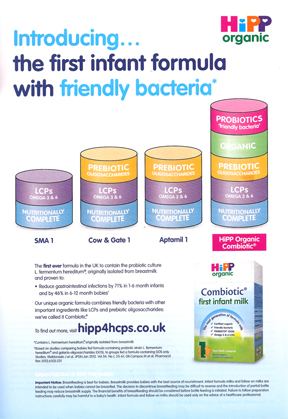
It comes down to its own profits and marketing campaigns. Hipp's current advertising and promotion is based on so-called probiotics added to its formula. There is no proven benefit of adding probiotics to formula, despite the impression given by Hipp in advertising such as that shown below (left, advertising to health workers, exposed on Baby Milk Action's Campaign for Ethical Marketing action sheet September 2012).

The First Steps Nutrition Trust guide to Infant Milks in the UK was updated in November 2012 to include information on Hipp's new probiotic formula and states:

A few clinical trials have shown health benefits for specific bacterial strains, however, on the strength of a review of randomised control trials in healthy term infants, the ESPGHAN (European Society of Paediatric Gastroenterology, Hepatology and Nutrition) Committee on Nutrition have found that there is too much uncertainty to draw any reliable conclusions on the efficacy of probiotics in infant milks. They did not recommend their routine use in formula milks for infants.

Water hot enough to kill harmful pathogens will also kill the probiotic bacteria and this is the reason Hipp is trying to hide the risks and ignore the safety guidance.

However, in doing so, Hipp is showing its contempt for the Infant Formula and Follow-on Formula Regulations (2007), adopted by the four countries of the UK. The Guidance Notes from the Food Standards Agency that accompany the Regulations and "shows how the regulations should be interpreted" is also very clear:

Labelling relating to the preparation, storage and disposal of infant formula and follow-on formula

24. Regulation 17 (1)(d) and 18(1)(d) require that instructions are provided for appropriate preparation, storage and disposal of the product. The Agency recommends that these instructions should include information noting that:

• Powdered infant formulae and follow-on formulae are not sterile, and as such can contain harmful bacteria. It is therefore important to be very careful when preparing formula to reduce the risks. Boiled tap water (not bottled water) cooled for no more than 30 minutes should be used to prepare infant feeds.

• All equipment used for feeding and preparing feed must be thoroughly cleaned and sterilised before use, and bottles should be made up fresh for each feed, as storing made-up formula milk may increase the chance of a baby becoming ill.

25. Further advice about the preparation and storage of formula can be found at the website below: http://www.breastfeeding.nhs.uk/en/materialforclients/index.asp (advice to consumers) http://www.dh.gov.uk/en/Healthcare/Maternity/Maternalandinfantnutrition/DH_ 4123674 (advice to health professionals)

The links mentioned in the Guidance Notes take you to the Department of Health booklet on formula feeding mentioned above, which states:

Bacteria in infant formula

Even when tins and packets of powdered infant formula are sealed, they can sometimes contain bacteria such as Cronobacter sakazakii (formerly know as Enterobacter sakazakii) and more rarely Salmonella. Although these bacteria are very rare, the infections they cause can be life-threatening.

To reduce the risk of infection, make up each feed as your baby needs it, using boiled water at a temperature of 70oC or above. Water at this temperature will kill any harmful bacteria that may be present.

Unfortunately, the regulatory authorities in the UK are not acting to enforce the regulations.

As Baby Milk Action also recently reported, the Advertising Standards Authority (ASA) is also failing to protect babies and their families in the UK when it comes to misleading claims made in advertisements. For example, it refuses to even investigate advertisments like that shown above. See our 24 October 2012 press release.

What can you do?
  • Direct people using formula to the above guidance so they know how to prepare it correctly.
  • Join Baby Milk Action (or send gift membership to a friend or collague).
  • Support our Campaign for Ethical Marketing.
  • Report examples of questionable promotion to the Baby Feeding Law Group monitoring project, which Baby Milk Action coordinates - click here.

Thursday, October 18, 2012

Comment on UNICEF breastfeeding report: Preventing disease and saving resources

UNICEF has published a report today called: "Preventing Disease and Saving Resources: the potential contribution of increasing breastfeeding rates in the UK". 

UNICEF'S press release states: "The report findings show that for just five illnesses, moderate increases in breastfeeding would translate into cost savings for the NHS of £40 million and tens of thousands of fewer hospital admissions and GP consultations."
See:
http://www.unicef.org.uk/BabyFriendly/News-and-Research/News/Breastfeeding-could-save-the-NHS-millions/

Here's a quick response from me, Mike Brady, Campaigns and Networking Coordinator at Baby Milk Action:

"This report is very welcome. The finding that babies who are not breastfed are more likely to become ill and require hospital and other medical treatment is neither surprising or new. The big question is will the present Government act when others have failed to do so in the past? Unfortunately, the current administration has taken steps backwards by, for example, scrapping the Infant Feeding Coordinator posts at the Department of Health despite these being one of the initiatives included in the Global Strategy on Infant and Young Child Feeding, which the UK claims to support. Some of the countries that have followed the strategy, including prohibiting the promotion of breastmilk substitutes in line with internationally agreed minimum marketing standards, have seen marked increases in breastfeeding rates, Brazil being a particularly good example. Of course, in parts of the world without the same level of health service support babies who are not breastfed are not only more likely to become ill, but more likely to die.

"Stopping baby milk company promotion has to be part of the public health policy response to this unnecessary illness and suffering. That is not to say that mothers who use formula should be made to feel guilty for doing so. Formula should be available for those who need it and everyone benefits if there is accurate independent information on infant feeding, instead of promotion from baby milk companies with a vested interest in selling their products. Don't forget, the millions companies spend on their promotion campaigns ultimately goes onto the price they charge for formula."

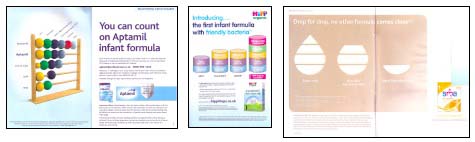
The following advertisements all appeared in the same health worker journal showing how each of the companies claims its formula is closer to breastmilk than the other brands. They cannot all be telling the truth. Unfortunately, the Advertising Standards Authority (ASA) refuses to investigate advertising in health journals. When Baby Milk Action has brought complaints about follow-on formula advertising to the public, the ASA has ruled against the claims that Aptamil and SMA are the best formulas. The claims do not stand up to scrutiny. Baby milk companies have shown they cannot be trusted to provide accurate information to parents or health workers. See: http://info.babymilkaction.org/cem/cemsep12


The Government has known about the health and financial impact for years of course. For example, in 2006 the National Institute for Clinical Excellence costed the savings to the NHS from a modest increase in breastfeeding rates (a 10% increase in initiation) and found many thousands of babies would not suffer illness and millions would be saved.

As UNICEF points out, the National Infant Feeding Survey tells us that 90% of mothers who stopped breastfeeding their babies by the time they were 6 weeks old wanted to breastfeed for longer. With greater support, many would have been able to do so, fewer babies would have become sick or even died and there would have been cost savings.

It is not just about support, of course. Breastfeeding is the normal way to feed a child. Denying a child breastmilk and giving it an alternative type of milk, even one processed to the best of current knowledge, is inevitably not going to be as beneficial. Breastmilk is a living substance and is a continuation of the nurture a mother has provided to her child through the placenta.

Formula is sometimes described a fourth best after breastfeeding, the mother's expressed breastmilk and donor breastmilk. Formula can save lives when breastmilk is unavailable either from the mother or donors, but modified cow's milk will always have limitations. In the UK, composition of formula is closely regulated so that those on the market have the ingredients known to be necessary. As scientific knowledge changes, the regulations are updated to change the composition. Mothers who do not breastfeed, or carers without access to breastmilk, can base their choice on their baby's preference and/or cost. Every company tries to claim its formula is better than the other brands, but this is marketing hype designed to inflate prices.

So aside from the short and long-term health impacts, financially the public is suffering a double whammy. As more tax money goes to paying for the care of babies who are not breastfed, parents who use formula are paying over the odds as prices are inflated to pay for the multi-million pound marketing campaigns run by the baby milk companies.

Based on figures from dairy farmers, the proportion of the selling price of formula that goes towards promotion and profit is between 53% and 80%. That means parents who use formula for 12 months are paying anything between about £231 and £884 towards promotion and profit. See:
http://info.babymilkaction.org/news/campaignblog310712

The latest marketing strategy of the baby milk companies is to claim they are friends of breastfeeding, wanting to offer advice and support to mothers. Danone claims that 3,000 mothers are signing up to its Cow & Gate branded baby club every week.

We have seen that companies have ostensibly given up on the first 6 months period, promoting their follow-on milk for use after breastfeeding for six months. This follows campaigns exposing their misleading claims and public health messages about the importance of breastfeeding. But companies ignore the fact that it is exclusive breastfeeding that is recommended for 6 months, with breastfeeding continuing beyond this age with the introduction of complementary foods. Companies also break the UK Infant Formula and Follow-on Formula Regulations (2007) and associated Guidance Notes by using the same brand names for follow-on milks and infant formula for use from birth and making the brand the focus of the advertising. See examples in the Baby Feeding Law Group monitoring project:
http://www.babyfeedinglawgroup.org.uk/reports/bflgreports
Involving baby milk companies in breastfeeding promotion is like putting the fox in charge of the chicken coop. We receive complaints about the outrageous emails mothers have received from companies. For example, Pfizer/Wyeth has promoted its SMA brand in an email headed: "How is feeding going?". It then plants seeds of doubt about breastfeeding:

"If you’re breastfeeding, do you sometimes wonder if your baby is getting enough milk?"

Although purporting to offer supportive advice, it highlights negatives:

"Feeling sore? .... If the pain continues or your nipples start to crack or bleed...."

Wyeth suggests people contact their midwife or public health nurse, "or call the SMA Careline".

After all that comes the closing punch: "Thinking of bottle feeding?" This is accompanied by an advertisement for SMA infant formula (which it is illegal to advertise) and the idealising claim (also prohibited) boasting the formula has "a new fat blend closer to that of breast milk".

The information that babies fed on the formula are more likely to become sick, be hospitalised and cost the NHS money treat is missing. As is the fact that these email marketing campaigns, the Careline, the cuddly toys, free gifts, free lunches for health workers and so on all go onto the price of formula.


What do parents really need? A free bear from Danone branded with its Aptamil formula name and logo (left) paid for by premiums on the price of formula - or accurate independent information on infant feeding from the health care system, no company promotion and cheaper formula?

Not for nothing are mothers supporting Baby Milk Action's "No promotion, cheaper formula" campaign. It doesn't matter if they are breastfeeding or using formula.
Everyone benefits by stopping baby milk company promotion:
http://www.change.org/petitions/baby-milk-companies-no-promotion-cheaper-formula

So why doesn't the Government act?

Why didn't it act in 2006 when the law was last revised and all health professional organisations, mother support groups and its own Scientific Advisory Committee on Nutrition called on it to prohibit company advertising, promotion and claims?

Why does it ignore the repeated calls from the UN Committee on the Rights of the Child to implement the internationally agreed minimum marketing standards, which companies should already be abiding by in the UK?

These are very good questions. Ask your Member of Parliament.

Thursday, September 13, 2012

Formula advertising in the British Journal of Midwifery

The British Journal of Midwifery has published a letter from Baby Milk Action after a member of its editorial board defended accepting infant formula advertising, which has been criticised by readers. Professor Lewis suggested that concerns about such advertising are due to "enmity and distrust" and suggested the priority should be on "resolving differences".

My letter is reproduced below.

In the guest editorial "Breast is best but choice is paramount" published in BJM 20(6), Prof. Lewis suggests that "concern and conflict must at some point give way to careful consideration, cooperation and hopefully, conciliation", but then attacks Baby Milk Action with bogus arguments. Indeed, the title of the editorial and its suggestion that stopping advertising restricts choice or denies information is itself bogus. Advertising, branded free gifts and branded competitions are not providing information, they are strategies designed to sell products.

The article states: "there is little evidence that Baby Milk Action are willing to acknowledge any positive changes within the food and infant feeding industry and against such enmity and distrust all future opportunities for an alliance and attainment of our wider aspirations for improved infant feeding is likely to founder." 

Baby Milk Action, which works to protect the right of all pregnant women and mothers to accurate, independent information, does acknowledge positive changes. For example, we welcomed Danone’s statement that it had taken action to stop 50% of the violations of the International Code of Marketing of Breastmilk Substitutes and subsequent, relevant Resolutions of the World Health Assembly in the last global monitoring report produced by the International Baby Food Action Network (IBFAN). We continue to communicate with Danone over ongoing systematic violations and it recently agreed to stop distributing materials in the health care system targeted at parents. While we publicly welcome these steps, we will continue to call for full compliance with the International Code and Resolutions, and for Danone to stop targeting health workers and parents in violation of these measures.

We are also in ongoing communication with Nestlé. Nestlé executives agreed to act on only 3% of violations (four out of 130) in the last monitoring report. I attended the Nestlé shareholder meeting this year and began by welcoming the fact that Nestlé had dropped a claim that one of its formula milks is "The new 'gold standard' in infant nutrition" after we campaigned on this. However, Nestlé continues to be the worst of the companies in terms of the scale and scope of violations and also takes the lead in opposing or undermining implementation of the Code and Resolutions in legislation. It is for this reason that it is the target of a boycott. The article refers to FTSE4Good without mentioning that Nestlé was only included in this ethical listing because the relevant criteria were weakened in September 2010 as no companies are complying with the previous criteria and FTSE wanted to bring some onto the list.
Article 7.2 of the Code states: "Information provided by manufacturers and distributors to health professionals regarding products within the scope of this Code should be restricted to scientific and factual matters". Formula advertising self-evidently does not provide scientific and factual information.

The Advertising Standards Authority (ASA) has upheld complains about formula advertising to the public, but refuses to consider complaints about advertising in professional journals on the grounds they should self-regulate. It is welcome to learn that there are health workers calling on the BJM to stop accepting formula advertising. This does not prohibit proper peer-reviewed scientific articles on formula appearing.

There is much more that could be said, but to finish, the article argues that various actors are "caught up on the particulars of the Code rather than finding a resolution for our differences." It is entirely sensible to expect companies to abide by these internationally agreed minimum standards for marketing of nutritional products for the most vulnerable people on the planet - babies. Putting priority on "resolving differences" with baby food companies, which in the BJM case coincidently involves profiting financially from the relationship, does a disservice to babies, their carers and readers of the BJM.

Yours sincerely,

Mike Brady
Campaigns and Networking Coordinator
Baby Milk Action

In a further response, Professor Lewis comments: "The ASA... accepts that adverts in healthcare journals are aimed at professionals who should be capable of considering the information and making up their own minds as to it benefits or disadvantage to the ways in which they practice – Baby Milk Action rather sadly, does not credit midwives with that capacity."

So if I understand this argument correctly, the British Journal of Midwifery abdicates its editorial responsibility and justifies pocketing money from baby food companies for publishing misleading advertising on the grounds that it is the responsibility of midwives to disregard it. To which I can only think, surely that's no way to run a journal.

Take a look at our September 2012 Campaign for Ethical Marketing to see how companies target healthworkers. And please let us know if you find Danone's leaflets in health facilities anywhere in the world.

Thursday, December 15, 2011

Product placement of baby milk in TV programmes is banned

Did you know that it is against the rules for television programmes to accept payment for showing baby milk in television programmes?

The ban is contained in the Ofcom Broadcasting Code.

Ofcom (the independent regulator and competition authority for the UK communication industries) introduced rules regarding product placement in television programmes in February 2011.

Products that cannot be placed in programmes include: "infant formula (baby milk), including follow-on formula". However, Ofcom does point out that some products may appear in programmes because they have been chosen by the producers as props. Companies can be fined for breaking the rules.

You can find the text of rules via the Law section of the Baby Feeding Law Group (BFLG) website and information on how to register a complaint in the Report violations section of the same site. Baby Milk Action coordinates the BFLG monitoring project.

Baby Milk Action submitted comments to the Ofcom and government consultations on the proposals, calling for all baby foods to be included in the ban. Our full submission can be downloaded by clicking here.

Was this useful? Please click here.

Thursday, September 30, 2010

You must be having a laugh!

Funny!

Thanks to VictoriaSlinglady for this.

Why 'Cow & Gate, pah'? If you are in the UK or Ireland, you may have seen that those nice people at Danone were inspired by an earlier laughing baby youtube clip when creating an advertisement for their Cow & Gate formula. This has claims suggesting the formula provides everything a baby needs. However, amongst other shortcomings, formula, unlike breastmilk, it is not a living substance. As a mother produces protective properties in response to infections in the environment, this is passed tailor-made through breastfeeding to a child at its most vulnerable time. In addition, powdered infant formula is not a sterile product, meaning it may contain harmful bacteria such as enterobacter sakazakii and salmonella. Thanks to our campaigning labels in the UK now warn that powdered infant formula is not sterile and instructions are improving, though need to be clearer about the importance of including a step of mixing up the powder with water above 70 degrees Centigrade to kill any bacteria that may be in the formula. The feeding bottle or cup should then be cooled before feeding to the child. For more on making formula feeding safer, see the infant feeding section of this site.

Unfortunately, Danone has little regard for providing accurate information and systematically violates the International Code of Marketing of Breastmilk Substitutes and subsequent, relevant Resolutions adopted by the World Health Assembly setting out minimum marketing standards. The UK Government has still not implemented these measures (despite repeated calls from the United Nations Committee on the Rights of the Child to do so) and the Advertising Standards Authority voluntary advertising code ignores the Code and Resolutions, even though companies should abide by them independently of government measures. However, even the ASA will sometimes take action and last week ruled against a Danone advertisement for Cow & Gate formula, in which the company made untrue claims implying a child over 6 months could only receive the iron it required through a processed milk. In truth a breasfed baby or a baby fed on infant formula, will receive the iron it needs through normal family foods introduced into the diet around that time. See:

http://www.campaignlive.co.uk/news/1029911/Cow---Gate-Milk-ad-banned-iron-claim/

Danone is laughing all the way to the bank since taking over the Nutricia, Milupa, Aptamil and Cow & Gate brands in 2007. At that time it promised Baby Milk Action a 'root-and-branch review' of marketing activities. Well, time is now running out and if the forthcoming global monitoring report produced by the International Baby Food Action Network (IBFAN) shows that Danone has not delivered on its promise and is getting as bad as Nestlé as it tries to compete with the worst of the baby food companies (which seems to be the case, particularly in Asia), then it will likely face consumer action. The Nestlé boycott is a key tool in forcing Nestlé to change policies and practices (click here for our current campaign action). If Danone won't change to abide by the marketing standards voluntarily, then it may be time to hit it in the pocket in the same way.

In the meantime, in the UK we continue to work to improve the formula marketing requirements to protect breastfeeding and protect babies fed on formula. You can support our current campaign by clicking here.

You might not feel like laughing now, so scroll up and watch that clip again!

Thursday, September 16, 2010

Midwives should tell Danone to keep its ill-gotten Aptamil loot

We are receiving many outraged reports from people who have seen that Danone is offering midwives grants of up to £1,000 from a fund of £20,000. This sponsorship is branded with the Danone formula name and logo, Aptamil (Danone is also behind the Nutricia, Milupa and Cow & Gate formula brands).

The money is being handled by the charity Tommy's. I would say Danone is using the charity to 'launder' the money in an attempt to make it more acceptable.

Firstly, for Tommy's and midwives to accept funds from Danone violates World Health Assembly marketing requirements.

Article 7.3 of the Code states:

"No financial or material inducements to promote products within the scope of this Code should be offered by manufacturers or distributors to health workers or members of their families, nor should these be accepted by health workers or members of their families."

Danone is promoting the Aptamil formula brand by linking the funding to it. The Aptamil logo features prominently on the charity's webpage and this links to an Aptamil-branded website that promotes the products with misleading claims.

It is not only a concern that Danone's money is linked to the Aptamil formula brand, accepting money from a formula company creates a conflict of interest for health workers. The World Health Assembly has adopted several Resolutions addressing conflicts of interest, such as Resolution 58.32, which calls for measures: "to ensure that financial support and other incentives for programmes and health professionals working in infant and young-child health do not create conflicts of interest."

A baby food company providing midwives with grants creates a conflict of interest, whatever the purported purpose of the grant.

Secondly, aside from these issues, we should not forget that Danone is second only to Nestlé for worldwide violations of the International Code and Resolutions. The only reason that Danone is not the target of a boycott like Nestlé is that after taking over the Aptamil and other brands from NUMICO in 2007, it promised to conduct a 'root and branch' review of marketing practices. All indications are that it has not taken the required action to end violations - quite the opposite. The next global monitoring report from the International Baby Food Action Network (IBFAN), due this year, will inform campaigners whether it is time to launch a consumer campaign against Danone to stop its aggressive marketing practices. The boycott of Nestlé has forced it to change some practices and is currently putting pressure on Nestlé to stop its latest global marketing campaign - click here.

In the UK, Danone brands have rulings against them from the Advertising Standards Authority for misleading parents. For example, the ASA upheld Baby Milk Action's complaints against advertising claims that Aptamil is the 'best follow-on formula' and protects against infection. See our press release from 22 July 2009.

Any health worker that has accepted Danone money is required to disclose this to their employers. Article 7.5 of the International Code states:

"Manufacturers and distributors of products within the scope of this Code should disclose to the institution to which a recipient health worker is affiliated any contribution made to him or on his behalf for fellowships, study tours, research grants, attendance at professional conferences, or the like. Similar disclosures should be made by the recipient."

Here is a quote from me, Mike Brady, Campaigns and Networking Coordinator, Baby Milk Action, for anyone that needs one:

"Danone is second only to Nestlé in the global baby milk market and pushes its products almost as aggressively. If it does not deliver on its promise to clean up the marketing for brands it took over when it purchased NUMICO, it will find itself, like Nestlé, the target of a consumer campaign.

"The money on offer is linked to a Danone formula brand name, Aptamil, and so is serving a promotional purpose. It is a breach of World Health Assembly marketing standards for companies to offer such financial benefits and health workers are also in breach of standards on conflicts of interest if they accept them. Even if this was not the case, the fact that Aptamil is promoted with misleading claims, some of which have rulings against them from the Advertising Standards Authority, shows this is a company that puts its own profits before the health and well-being of mothers and babies and its ill-gotten loot should be untouchable by those wanting to protect and support mothers and babies."

You can see examples of Danone violations of the International Code and Resolutions in the UK in the monitoring reports Baby Milk Action produces for the Baby Feeding Law Group.

Saturday, August 21, 2010

Ulverston Breastfeeding Festival

The First Ulverston Breastfeeding Festival (16 - 22 August) was a thoroughly enjoyable event and one that deserves to grow. The town of Ulverston, close to the coast on the south side of the Lake District, is a delightful setting. I spoke on Friday in the Parish Church Hall, after a showing of the UNICEF Philippines film, Formula for Disaster. Many thanks to Jo Dawson for the invitation and for the hard work she put in with help from friends and family to make the event a reality. I really hope it becomes part of the calendar and inspires others in the UK and elsewhere.

There are links to the film and some of the information included in my presentation below, along with other news from the festival. My weekend at the festival was an opportunity to encourage people to email Nestlé over its latest baby milk marketing strategy (it is claiming its formula 'protects' babies, despite the fact that babies fed on formula are more likely to become sick than breastfed babies and, in conditions of poverty, more likely to die). Before reading on, take a minute to email Nestlé by clicking here (will open in a new window).

Breastfeeding FestivalThere were events throughout the week, including workshops and talks on baby-led weaning, milk banking, breastfeeding information for grandparents and the Breastfeeding Manifesto. There was a breastfeeding fair on the Saturday in the Coronation Hall, with stalls by Baby Milk Action and other organisations involved. Sedleigh played his song 'Every Drop Counts' and other music outside the hall - close to statues of Ulverston son, Stan Laurel, and his partner in comedy, Oliver Hardy.

The Madonna and Child Project is running until 28 August, an exhibition of beautiful, iconic mother and baby portrait prints with associated birth stories, by Canadian artist Kate Hansen.

At the beginning of the week, breastfeeding mothers gathered for the Big Breastfeeding Picture, which helped to gain coverage in the local media. There were various café events during the week as well, for a more informal chat over tea, coffee and cake or something more substantial. On Sunday morning, before the final café gathering, some of us climbed Hoad Hill, for amazing views over Morecombe Bay towards Blackpool on one side, the peaks of the Lake District on the other and in the far distance, the peaks of Yorkshire.

Ulverston has a series of festivals throughout the year, and anyone entering the town could not miss the signs saying the current one was The Breastfeeding Festival.

So why not plan a visit to the area next August to coincide with the Festival? Windermere and Coniston lakes are very close by with extensive tourist facilities and Ulverston itself offers camping, B&B and hotel accommodation. For a taste of what to expect, take a look at this year's programme: http://www.thebreastfeedingfestival.btik.com/p_People.ikml

You can view the film about infant feeding in the Philippines online by going to: http://boycottnestle.blogspot.com/2007/05/watch-film-from-philippines-here.htm.

In my talk I provided an update on what happened since the film. You can find much of the information here.

I then spoke about the situation in the UK. Here's a youtube clip I put together for the launch of the ONE MILLION CAMPAIGN last year, which has some of the information.

Click here to sign the ONE MILLION CAMPAIGN petition.

You can the text of a similar talk, with the powerpoint presentation, here:
http://info.babymilkaction.org/news/campaignblog070310

Gillian Weaver, Chair of the UK Association of Milk Banking, told me about this great clip about a recent fundraising cycle ride by supporter, Steve Haberfield.

You can hear more of the song Every Drop Counts, by Sedleigh below. Sedleigh performed this and other songs live outside the Coronation Hall and at one of Gillian's talks. If you make a donation to the work of UKAMB, you will be sent the full song. See: http://www.ukamb.org/edc/index.html

Remember you can find news of forthcoming events on our diary dates page and we'll post up the dates for the Ulverston Breastfeeding Festival 2011 event when we have them and hope we can take part once again.

Saturday, July 24, 2010

Campaign to Simplify the UK Infant Formula and Follow-on Formula Regulations

The newly formed coalition Government in the UK has prioritised cutting public expenditure and the deficit and has also launched a campaign to scrap or amend unnecessary or ineffective legislation. The public are being invited to submit suggestions.

Baby Milk Action is suggesting the Government simplify the Infant Formula and Follow-on Formula Regulations. You can support this suggestion by clicking on the 5th star under the heading 'Add a Rating' and leaving comments on the Government website - click here.

The regulations in their current form place an unnecessary burden on business, the public and enforcement authorities by treating infant formula and follow-on formula differently. When the last government was revising the Regulations, public bodies such as Trading Standards and the Scientific Advisory Committee on Nutrition called for the ban on promoting infant formula to all breastmilk substitutes, including follow-on formulas. This was not done. In a review commissioned by the last government, Trading Standards and the umbrella body submitted evidence and stated: "One of the major problems for enforcement officers is the use of advertising and promotional material which blurs the distinction between follow-on formula and infant formula."

Health experts, including the Baby Feeding Law Group, a coalition of 23 health worker and mother support organsiations, called for the law to be brought into line with the International Code of Marketing of Breastmilk Substitutes and subsequent, relevant Resolutions of the World Health Assembly. Baby Milk Action prepared a report (left) that was submitted to the consultation on the law that took place in 2006 that sets out the changes required (click here to access). This references studies by public bodies such as the National Institute for Clinical Excellence that show savings that could be made to the National Health Service by small increases in breastfeeding rates. Simplifying the formula marketing regulations in the way we are proposing, would help to achieve this.

Prohibiting the promotion of breastmilk substitutes does not prevent them being sold. Formula will still be available for those that need it and our proposals will ensure those who use formula have the information they need to reduce risks.

In the General Election in May 2010, the Liberal Democrats, who are now part of the coalition government, supported our pledge saying they will work for the International Code and Resolutions to be implemented in the UK and elsewhere. Now it is time to act on this pledge.

Click here to give your support to our proposal for simplifying the law by clicking on the 5th star under 'Add a Rating' and leave a comment.

Promotion of artificial feeding takes many forms. Our partner in the BFLG, the National Childbirth Trust, is currently highlighting how exam bodies are even playing a role in promoting formula and attacking those who call for companies to abide by the international marketing standards. See the NCT press release at:
http://www.nct.org.uk/press-office/press-releases/view/224

Monday, May 03, 2010

Making a mark in the UK General Election

I've just sent out a press release with the news that the Liberal Democrats have pledged their support to our campaign to protect infant health. We have asked the parties vying for power in the UK General Election to pledge to work for the implementation of the World Health Assembly marketing requirements in the UK and support these minimum standards internationally. The Green Party and Scottish Green Party have also made this pledge. We wrote to all party leaders as part of our Make a Mark in 2010 activities.

The Liberal Democrats have sometimes been in second place in polling in the lead up to the vote, which takes place on 6 May and may hold the balance of power if no party wins an outright majority. The Scottish Green Party is already represented in the Scottish Parliament and the Greens are hoping to enter the UK Parliament at this election. We are still waiting for position statements from the other parties.

You can find out more from the press release - where you can also download a leaflet including the pledge. If you are in the UK, ask candidates in your constituency to make the pledge. See:

http://info.babymilkaction.org/pressrelease/pressrelease03may10

Friday, April 16, 2010

Vote for babies in the UK General Election

I've just posted a new page on our website with a leaflet for the UK General Election campaign. See:

Monday, March 22, 2010

Corporate influence on the UK Government

A investigative television programme on Channel 4's Dispatches in the UK is reporting on how corporate lobbyists recruit politicians to gain access to Government Ministers and the Chairs of influential Parliamentary committees.

A former Minister, Stephen Byers MP, has been secretly filmed at a bogus lobbying company set up by the journalists describing himself as like a 'cab for hire' at £ 3,000 - £ 5,000 per day. He claimed he had been able to get labelling regulations changed for a supermarket client. Since realising he was being filmed, he has claimed that he had been exaggerating and the Ministers he claimed to have lobbied have said that he had not contacted them and they had not changed regulations.

The Guardian reports on this today and states that Harriet Harman, the leader of the Commons, told MPs, "I want to reassure honourable members and the public that ministers act in the public interest. They make decisions in the public interest. It is an absolutely fundamental part of the duties of their office."

I commented on the article as follows:

Having seen how Ministers behaved when drafting the Infant Formula and Follow-on Formula Regulations, I question this statement.

All leading health worker bodies, mother support groups and the UN Committee on the Rights for the Child have called on the Government to bring the law into line with minimum international standards to protect breastfeeding and babies fed on formula. The Government's own Scientific Advisory Committee on Nutrition, Trading Standards and LACORS also called for stronger measures.

The Government followed the industry line of doing the minimum possible. In part they were concerned at upsetting the European Commission by going further than its weak Directive - but other countries did go further. They were also concerned about legal action - and were taken to the high court by the industry in 2008 as it successfully tried to delay some of the measures coming into force.

So putting corporate interests before the public interest is not necessarily due to dodgy dealings - it may be down to lack of courage.

An Independent Review Panel has just reported and noted the problems with enforcing the law and calling for the Government to take steps. It now has the justification to strengthen the law. The Panel even suggested the Government could cite the precautionary principle to do so.

The question is will they, or whoever forms the next government, act to protect infants and mothers? And if not, why not? See:
http://info.babymilkaction.org/pressrelease/pressrelease11mar10a

There are reasons to be concerned about corporate influence or at least mindset. The head of the Food Standards Agency came from the dairy industry.
http://boycottnestle.blogspot.com/2007/12/uk-formula-influence.html

And the Independent on Sunday reported in 2008: "Rosie Cooper, a parliamentary private secretary to the Health minister Ben Bradshaw, is undergoing a year-long Industry and Parliament Trust fellowship with Nestlé."
http://boycottnestle.blogspot.com/2008/05/nestle-uk-government.html

She and other MPs also enjoyed a trip to South Africa at Nestlé's expense. Nestlé, the most boycotted company in the UK and one of the four most boycotted on the planet, over the way it markets baby milk. A company the Department of Health in South Africa was taking to task at the time over the claims it is using on the labels for its baby milk, which mislead mothers.

Monday, January 04, 2010

Early use of the Freedom of Information Act by Baby Milk Action

As The Guardian reports today, the UK Freedom of Information Act is five years old:

I used the FOI Act back in 2005 to obtain information from Ofcom regarding a television sponsorship by Heinz for Farley's formula. Advertising of infant formula is illegal in the UK, but follow-on formula advertising is allowed.


For more details on the advertising campaign and complaint see:

International standards prohibit all advertising and make health workers responsible for advising parents (companies are limited to providing scientific and factual information to health workers). We see companies exploit this loophole in adverts that are ostensibly for follow-on formula, but promote the full range and direct parents to websites where infant formula is promoted. They also make health claims that are not substantiated by evidence, for example, claiming that formula builds the immune system whereas babies fed on it are more likely to become sick than breastfed babies (we have won cases at the voluntary Advertising Standards Authority, but that system does have serious flaws - another story).

Now, Ofcom had rejected a complaint about Heinz Farley's formula advertising (strapline 'closer - by nature') appearing on the Discovery channel and elsewhere, claiming it was clearly for follow-on formula. We said this was ridiculous as the only clue was the colour of the packshot in the advertisement.

The FOI Act led to a stack of document on the case (including copies of the letters I had sent to Ofcom), which included an email from Hillingdon Environmental Health (the home authority for Heinz) to Ofcom saying:

“I was unable to work out the precise product pictured in the video footage.”

There was also a reply from Ofcom’s investigator agreeing:

“I don’t know what product appears in the credits as no information is given on the pack shot. Discovery have told us that the product was follow-on formula.”

So Ofcom had let Heinz through the loophole, even though their own expert was confused. In its written response Ofcom had suggested it was obvious what product was being advertised : “...the purple background correlated with follow-on products. We do not see therefore where the connection to infant formula can be made.”

As a footnote, following on from this and other examples of the loophole being exploited, all UK health bodies and the government's own Scientific Advisory Committee on Nutrition called for follow-on formula to be treated the same as infant formula as regard advertising. However, the government refused these requests when introducing new legislation in 2007, instead following the industry line.

We continue to monitor and expose how the law is failing mothers and babies and call for the international standards introduced by the World Health Assembly to be implemented in the UK. See:

Saturday, October 24, 2009

UK law review draft report is a whitewash that side steps the real issues so as to clear formula promotion

If you are in the UK, please check out the latest news about our baby formula marketing regulations. Baby Milk Action has launched a quick campaign to protect breastfeeding and babies fed on formula and we need you help!


A government commissioned report on the effectiveness of the law has just been published as a draft. It is a whitewash. The Independent Review Panel did not examine how advertising and other promotion of formula undermines breastfeeding and misleads parents who use formula. Instead it only considered whether follow-on formula is being fed to babies under 6 months instead of infant formula by mistake.

On this basis it concludes there is basically no problem with the current law which allows companies to target mothers with promotional materials and inaccurate information, to offer gifts, advertise, make point-of-sale promotion, give inducements to health workers etc. etc.

The law should be protecting breastfeeding and protecting babies fed on formula. It is failing in this, as the evidence clearly shows - if the Panel would just consider it. This is contained in monitoring reports prepared by Baby Milk Action and in other submissions, including from Trading Standards, which has the task of enforcing the law.

You can send a message to the Minister for Public Health asking the government to send the report back to include these issues, or to otherwise reject it as a waste of public money. See:

Wednesday, August 12, 2009

Danone censured again for misleading parents over Milupa Aptamil formula

Danone picked up another ruling against its Milupa Aptamil follow-on formula this week from the UK Advertising Standards Authority (ASA). This time it was for its television advertising, which suggests that Aptamil protects babies against infections because it contains IMMUNOFORTIS - a made up name, which is itself an idealizing claim.

Two weeks ago the ASA ruled Danone could not claim that IMMUNOFORTIS protects against infection or that Aptamil is the 'best follow-on formula' and that it had breached the Advertising Code's clauses on substantiation, truthfulness and comparisons. See:

Baby Milk Action did not figure in the latest ruling, and we were not aware of or consulted on the draft ruling or invited to submit evidence. This is surprising as we have been complaining about the television advertising to the authorities since it appeared and featured it as an example of malpractice in the monitoring reports we produce for the Baby Feeding Law Group, which are submitted to the ASA. It was listed in the March 2009 report as 'ASA investigating' - but we were not subsequently contacted. See:

Congratulations to the members of the public who registered complaints with the ASA. Despite these recent rulings, the ASA has a very poor record in even taking up the cases reported to it, generally rejecting them out of hand. It has also rejected the role assigned to it in the Guidance Notes accompanying the Infant Formula and Follow-on Formula Regulations 2007 (see correspondence in the March 2009 report stating: "We have no remit or authority to apply standards to promotions or communications that are beyond the scope of the Codes (regardless of the sector in question) and the ASA Council cannot be bound by the content of a guidance document."

The advertisements show a protective glow around children fed on Aptamil, with the suggestion this wards of germs, such as when other children sneeze on them.


Monday, June 22, 2009

Fundraising to hold UK formula companies to account

We are waiting for the UK government's review panel to give its recommendations on what to do in response to continued aggressive marketing of formula following the introduction of the new Infant Formula and Follow-on Formula Regulations 2007 and the associated guidance notes.

As the monitoring reports we produce for the Baby Feeding Law Group (BFLG) show, violations remain 'commonplace' - to use the word of the UN Committee on the Rights of the Child in its assessment of the government's performance in protecting child rights. The Committee, like all health worker bodies, mother support groups and the government's own Scientific Advisory Committee on Nutrition have called for stronger regulations.

We continue to monitor the companies and will be producing a further report in the coming months. The next report will respond to the action - or lack of it - taken by the review panel. It will also go to the home authorities responsible for enforcing the regulations, to the Advertising Standards Authority and the Food Standards Agency. As the latest report shows, this has stopped some questionable marketing practices, but has mainly demonstrated the failings of the current regulatory and enforcement system.

To do this work, we rely on the support of volunteer monitors (some of whom we have trained), donations and sales of reports.

We are grateful to LatchOn.org for listing our project on its site at:

You can make a donation via that site or the BFLG site:

You can download the latest report and purchase a printed copy at:

Friday, June 05, 2009

Martek profits boosted by formula company bogus claims

Martek, the company that produces Long Chain Polyunsaturated Fatty Acids, from algae for adding to formula is doing well for itself.

The BioHealth Investor site reports "its fiscal 2009 second-quarter profit rose by 20 percent"

Why such demand for LCPUFAs? The report notes: "Omega-3 fatty acids are believed to play an important role in brain and eye development."

True, as far as it goes. Adding processed LCPUFAs to formula, a different environment to breastmilk, where human LCPUFAs naturally occur, is not found to provide any benefit.

The independent and respected Cochrane Library reviewed the evidence and concluded:

"It has been suggested that low levels of long chain polyunsaturated fatty acids (LCPUFA) found in formula milk may contribute to lower IQ levels and vision skills in term infants. Some milk formulas with added LCPUFA are commercially available. This review found that feeding term infants with milk formula enriched with LCPUFA had no proven benefit regarding vision, cognition or physical growth."

Of course, the facts do not prevent Nestlé claiming its formula with LCPUFAs contains 'brain building blocks' or UK formula companies claiming they benefit brain and eye development. The companies do not follow the marketing requirements adopted by the World Health Assembly unless forced to do so.

This need not worry investors however. As Hambrecht & Quist said when it strongly recommended investors to buy shares in Martek Biosciences in the 1990s when it launched its Formulaid LCPUFA additive:

"The history of infant formula has shown that virtually all similar examples have led to wide-scale introduction of such additives into infant formula, even if there was no evidence that the additives were important. Infant formula is currently a commodity market with all products being almost identical and marketers competing intensely to differentiate their product. Even if Formulaid had no benefit we think that it would be widely incorporated into most formulas as a marketing tool and to allow companies to promote their formula as 'closest to human milk.'"

The question that parents need answered is whether it is worth spending more on formula that contains LCPUFAs. We have to direct parents to their health worker for information. However, as the World Health Assembly marketing requirements are not enforced in many countries, we know that health workers are not only misled by companies, but bombarded with gifts and hospitality to influence their views of the companies and their claims.

The official UK Department of Health line is that all formulas have to comply with composition standards so all formulas are equally suitable. There is no requirement to add LCPUFAs as there is not proven benefit from adding them. They are, however, believed to be safe.

The formula marketing regulations in the UK allow companies to add new ingredients to formula without proving their benefit or even safety: all they have to do is submit a copy of the label they plan to use to the Food Standards Agency.

This means that we are seeing what some have described as mass uncontrolled trials on populations of babies. While some parents may be persuaded to use formulas with LCPUFAs just in case, there is also the possibility that there may be unknown risks. In the US, a freedom of information request found that the Food and Drug Administration had registered reports from parents who believed their babies had had an adverse reaction to these ingredients. See:

Formula is a nutritional medicine and, like any medicine, is intended for specific cases where it is needed. If it can be avoided, then the known health risks and possible unknown ones can also be avoided. This common sense approach is lost in the hype around formula - hype which is intended to make formula use seem to be a simple question of lifestyle so as to boost sales and profits for companies such as Martek.

It is a mother's right to decide how to feed her child and no-one should try to make her feel guilty for her decision: there are many factors involved.

It is not my purpose in pointing out what companies hide to make mothers feel guilty, but to shame our politicians for allowing companies to make bogus claims. My purpose is to defend a mother's right to make an informed decision. If she decides to use formula afterwards in any case, a decision based on facts rather than misinformation should be empowering.

While we have to be aware that some mothers feel pressured to breastfeed and demonised if they decide not to (or have no choice), I think it is also wrong and patronising to believe or argue that information should be kept hidden.

Those that use formula require better information: independent, objective information from health workers that have not been targeted by companies seeking to increase sales.

Friday, May 08, 2009

A talk for UK National Breastfeeding Awareness Week

National Breastfeeding Awareness Week begins next week and I've prepared a youtube talk to mark it.

This is a good time to remember that companies continue to undermine breastfeeding and put formula-fed babies at risk with their practices. Governments in many countries are failing to stop them, including here in the UK.

Our colleagues in India launched the ONE MILLION CAMPAIGN to gather signatures on a petition calling for our leaders to act. I've prepared a powerpoint presentation and talk about this, which anyone is welcome to adapt for their own use. Just contact me.

It is available on youtube with me giving the voice over. Take a look and if you find it useful, pass it on. Whatever, please sign up to the ONE MILLION CAMPAIGN at:

Tuesday, April 14, 2009

Action to protect infant health - events coming up in May

Here is a round up of news and coming action, covering:

* Our new UK monitoring report: Hard Sell Formula 2009.

* Gather signatures for the ONE MILLION CAMPAIGN ready for the World Health Assembly in May 2009.

* Demonstration at Nestle (UK) HQ, Croydon, 16 May 2009.

Our new UK monitoring report: Hard Sell Formula 2009.

Thank you to everyone in the UK who has provided monitoring evidence to the project we run on behalf of the Baby Feeding Law Group. This evidence goes into reports sent to the UK enforcement authorities and the government panel reviewing the law. Past reports have profiled the main companies. The March 2009 follows an alternative approach, giving an overview of marketing strategies.


The strategies covered are:
  • START before they are born...
  • PUSH in supermarkets...
  • IDEALISE products...
  • OFFER gifts...
  • ADVERTISE...
  • CO-OPT health workers...
The report can be downloaded free of charge. Printed copies can be purchased, which helps to fund the project. See:
http://www.babymilkaction.org/shop/publications01.html#bflgreports


Gather signatures for the ONE MILLION CAMPAIGN ready for the World Health Assembly in May 2009.

The World Health Assembly in May will be examining various health issues and members from the International Baby Food Action Network (IBFAN) from several countries will attend to inform policy makers about the latest concerns regarding infant feeding. The practices exposed in our monitoring report and those of other groups around the world show the need for action to strengthen and enforce marketing standards.

To help gain policy makers' attention, people are signing a petition calling for action to protect breastfeeding. If you haven't signed already, you can do so at:
http://www.onemillioncampaign.org/en/Details_Petitions.aspx

If you have a blog or website, why not add the logo shown on this blog?

For other ways to promote the campaign see the Facebook group at:
http://www.facebook.com/group.php?gid=50360141389


Demonstration at Nestle (UK) HQ, Croydon, 16 May 2009.

The annual demonstration at Nestle (UK) HQ will take place from 11:00 - 12:00 on Saturday 16 May 2009.

If you can't make it to Croydon, why not hold a demonstration at another site linked to Nestle, such as a factory, a Body Shop outlet (part-owned by Nestle) or shops selling Nestle goods?

You can find information and resources at:
http://www.babymilkaction.org/action/demo09.html

Also see the boycott section of our online Virtual Shop for useful materials:
http://www.babymilkaction.org/shop/boycott.html

You can also support the online virtual demonstration, by signing up on Facebook at:
http://www.facebook.com/event.php?eid=59171734370

Friday, January 16, 2009

John Lewis violating children's rights with breach of baby bottle marketing standards

Lot's of people have been contacting us about the John Lewis Baby feeding advisors promoting Avent feeding bottles in stores in the UK.

If you went along, reports of what you were told and scans of materials you may have received (or pop copies in the post) are most welcome. Report using the forms at:
http://www.babyfeedinglawgroup.org.uk/monitoring.html

This is a blatant violation of the International Code of Marketing of Breastmilk Substitutes.
http://www.ibfan.org/site2005/Pages/article.php?art_id=52&iui=1#2

Article 2: The Code applies to the marketing, and practices related thereto, of the following products: ... feeding bottles and teats.

http://www.ibfan.org/site2005/Pages/article.php?art_id=52&iui=1#5

Article 5. The general public and mothers

5.1 There should be no advertising or other form of promotion to the general public of products within the scope of this Code.

5.2 Manufacturers and distributors should not provide, directly or indirectly, to pregnant women, mothers or members of their families, samples of products within the scope of this Code.

5.3 In conformity with paragraphs 1 and 2 of this Article, there should be no point-of-sale advertising, giving of samples, or any other promotion device to induce sales directly to the consumer at the retail level, such as special displays, discount coupons, premiums, special sales, loss leaders and tie-in sales, for products within the scope of this Code....

5.5 Marketing personnel, in their business capacity, should not seek direct or indirect contact of any kind with pregnant women or with mothers of infants and young children.
---

We are discussing with the authorities what action can be taken. There is a problem in the UK, however. The United Nations Committee on the Rights of the Child explained it in October 2008 when it's report on the UK stated it: "is concerned that implementation of the International Code of Marketing of Breastmilk Substitutes continues to be inadequate and that aggressive promotion of breastmilk substitutes remains common."

Marketing regulations for bottles and teats are less than inadequate, they are not included in the Infant Formula and Follow-on Formula Regulations, which the government points to as its implementation of the Code.

The feeding bottle promotion is being done along Avent breastpumps, but there is reason to be seriously concerned at the message the John Lewis Baby feeding advisors will be giving out. This is what they say on the John Lewis website : "There’s been a lot of talk, and quite a bit of controversy, about which is best for baby - breast or bottle."

If the advisors have not even read the 'breastfeeding is best for babies' message on formula or the reasons for it, what can be expected of them?

Certainly all mothers need support and information, but company representatives with a vested interest in selling products are not the best people to be targeting mothers.

Please let us know your experience if you went to an event in what was billed as 'Avent Feeding Awareness Week' or are able to go this weekend.